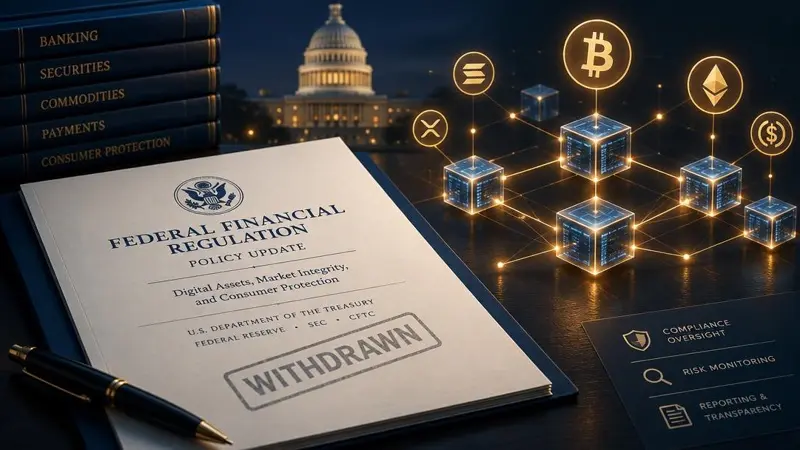
FinCEN has withdrawn two proposed digital asset rules, the unhosted wallet transaction proposal and the convertible virtual currency mixer special measure. Here's why withdrawing a proposal is not the same as repealing a rule, and why BSA, AML, OFAC, SAR, and KYC obligations for crypto businesses continue unchanged.
FinCEN is withdrawing two digital asset proposals: the unhosted wallet transaction rulemaking and the convertible virtual currency mixer special measure
The U.S. Department of the Treasury's Financial Crimes Enforcement Network (FinCEN) has announced that it is withdrawing two proposed rules involving convertible virtual currencies (CVCs) and digital assets. The first would have imposed new recordkeeping, identity verification, and reporting requirements on certain transactions involving convertible virtual currencies or digital assets and unhosted wallets. The second was a proposed special measure that would have treated convertible virtual currency mixers as a class of transactions of primary money laundering concern. FinCEN said it considered the comments submitted in response to both proposals and is withdrawing them as part of the administration's broader deregulatory agenda and its effort to ensure digital asset regulations are fit-for-purpose.
For compliance officers, executives, crypto businesses, money services businesses, fintech companies, and payment firms, the most important thing to understand is what this announcement does not mean. Withdrawing a proposed rule is not the same as repealing an existing regulation, and it is not the same as eliminating the anti-money-laundering obligations that already apply to digital asset activity. The Bank Secrecy Act (BSA), FinCEN's money services business rules, the Travel Rule, Suspicious Activity Report (SAR) requirements, customer identification (KYC) and customer due diligence, OFAC sanctions screening, and state money transmitter licensing all remain in force. This article explains each of those distinctions in plain English.
Neither proposal was ever finalized or in force, so withdrawing them removes no existing compliance obligation, it only removes proposed new ones
What Did FinCEN Withdraw?
FinCEN withdrew two separate proposals that had been published for public comment. Both concerned the intersection of the federal anti-money-laundering framework and digital assets, but they addressed different risks through different legal mechanisms.
The first proposal, titled Requirements for Certain Transactions Involving Convertible Virtual Currency or Digital Assets, was a rulemaking that would have imposed additional recordkeeping, identity verification, and reporting obligations on certain transactions involving convertible virtual currencies or digital assets and so-called unhosted (self-custodied) wallets. It was aimed primarily at transactions between financial institutions and unhosted wallets held by their customers.
The second proposal, titled Proposal of Special Measure Regarding Convertible Virtual Currency Mixing, as a Class of Transactions of Primary Money Laundering Concern, was a proposed special measure under Section 311 of the USA PATRIOT Act. It sought to designate convertible virtual currency mixing as a class of transactions of primary money laundering concern and to impose heightened recordkeeping and reporting requirements on covered institutions that process those transactions.
FinCEN is withdrawing both. Neither was ever finalized, and neither was ever in force. That point matters: a withdrawn proposal leaves no compliance obligation behind, because a proposal that has not been finalized has not yet created one.
Withdrawing a proposal is legally distinct from repealing a regulation; the underlying BSA, FinCEN, and OFAC frameworks remain fully in effect
The Unhosted Wallet Proposal, Explained
The unhosted wallet proposal would have created a new category of recordkeeping and reporting obligations for transactions between a regulated financial institution and an unhosted wallet, a wallet where the customer, rather than a third-party custodian, controls the private keys. In simple terms, the proposal sought to bring certain transactions that touch customer-controlled wallets into the same recordkeeping and reporting framework that already applies to transactions between two financial institutions.
Under the proposal as drafted, covered institutions would generally have been required to verify the identity of their customer (and, in some circumstances, the counterparty) and to keep records for certain transactions above a defined threshold involving CVC or a digital asset and an unhosted wallet. Some transactions, particularly those involving a foreign-located counterparty or a counterparty the institution could not identify, would also have triggered a reporting obligation to FinCEN, similar in character to a Currency Transaction Report.
It is important not to overstate the scope. The proposal would not have subjected every transaction involving CVC or an unhosted wallet to identical requirements. The obligations were structured around specific transaction types, thresholds, and counterparty characteristics. The withdrawal means none of those obligations take effect. But the withdrawal does not change the fact that a financial institution must still comply with the KYC, recordkeeping, monitoring, and reporting rules that already apply to its business today.
Digital asset transactions are NOT free from BSA, AML, OFAC, sanctions, SAR, KYC, monitoring, or Travel Rule obligations
What Is an Unhosted or Self-Custodied Wallet?
An unhosted wallet, also called a self-custodied or non-custodial wallet, is a wallet for holding digital assets where the owner controls the private keys directly, rather than holding the assets through a third party such as an exchange or custodian. A hosted wallet, by contrast, is one where a third-party service holds the keys on the customer's behalf, the way a bank holds a depositor's funds.
The distinction matters for AML purposes because a hosted wallet provider is typically a regulated intermediary that must perform identification, monitoring, and reporting, while an unhosted wallet has no intermediary between the owner and the blockchain. Regulators have long viewed the movement of value between the regulated financial system and unhosted wallets as an area where visibility is reduced, which is why the earlier proposal focused on it. The withdrawal of that proposal returns the treatment of unhosted wallet transactions to the existing framework, which already requires financial institutions to apply risk-based monitoring to their customers' activity, including activity that touches self-custodied wallets.
An unhosted (self-custodied) wallet is one where the owner controls the private keys; transactions touching them remain subject to existing risk-based monitoring
The Cryptocurrency Mixer Special Measure Proposal
The second proposal sought to use FinCEN's authority under Section 311 of the USA PATRIOT Act to designate convertible virtual currency mixing as a class of transactions of primary money laundering concern. A special measure is a focused, powerful tool: when FinCEN finds that a class of transactions or an institution is of primary money laundering concern, it can impose heightened recordkeeping, reporting, and identification requirements, or in the strongest form, restrict or prohibit certain dealings.
In this case, the proposed special measure would primarily have required covered financial institutions to keep records and file reports on transactions involving CVC mixing. In its earlier public statements, FinCEN has described mixing, and its misuse by illicit actors, as a significant money laundering vulnerability. The proposal was aimed at the mixing activity as a class of transactions, not at a specific mixer or a specific country. Withdrawing the proposal means that special-measure framework is not being adopted at this time.
Here again, the nuance is critical. Withdrawing the mixer special measure does not remove any obligation a covered institution already has to detect, investigate, and, where warranted, report suspicious activity connected to mixers or any other high-risk transaction. Sanctions exposure tied to specific designated mixers also remains entirely separate and unaffected by the withdrawal.
Sanctions obligations tied to specifically designated mixers are separate from FinCEN rulemaking and are unaffected by the withdrawal
What Is a Convertible Virtual Currency Mixer?
A convertible virtual currency mixer, sometimes called a tumbler, is a service or protocol that combines digital assets from multiple users and redistributes them, with the goal of obscuring the link between the source of the funds and their destination. Mixers are used for legitimate privacy purposes and for illicit purposes alike, and FinCEN and other regulators have repeatedly highlighted the use of mixers by ransomware operators, fraudsters, sanctions evaders, and other illicit actors.
Because mixers deliberately break the on-chain link between the origin and destination of funds, transactions that flow in or out of mixing activity can be difficult to trace. That is precisely why the earlier proposal targeted them. The withdrawal removes the specific special-measure mechanism, but it does not remove the underlying obligation to identify and, where appropriate, report suspicious activity. A covered institution that handles activity connected to a mixer should still evaluate it under its existing risk-based monitoring and suspicious activity procedures.
FinCEN framed the action around a deregulatory agenda and "fit-for-purpose" regulation, not an end to digital asset oversight
Withdrawal vs. Repeal vs. Continuing Obligations
This is the distinction that most often gets lost in headlines, and it is the heart of understanding FinCEN's announcement. There are three very different legal situations, and they should never be treated as interchangeable:
| Situation | What it means | Effect on obligations |
|---|---|---|
| Proposal withdrawn (this announcement) | A rule that was proposed but never finalized is taken off the table. It never created an obligation. | No new obligation takes effect; nothing that was already required goes away. |
| Existing regulation repealed | An active, final rule is removed through rulemaking. | Obligations created by that specific rule would end, but only that rule. |
| Existing framework continues | Long-standing BSA, AML, sanctions, and licensing requirements remain in force. | Obligations that existed before the proposals are unaffected. |
FinCEN withdrew proposals. It did not repeal the BSA. It did not repeal the money services business rules. It did not repeal the Travel Rule, the Customer Due Diligence Rule, SAR obligations, or OFAC sanctions requirements. Every one of those frameworks existed before these two proposals were published, and every one of them continues to apply exactly as before. If a business was subject to BSA/AML obligations last month, it is still subject to those obligations today.
Crypto businesses should confirm classification, review policies against existing rules (not the withdrawn proposals), re-test monitoring, and refresh training
What Still Applies to Digital Asset Businesses
The two withdrawals change only the proposed additions; they do not touch the existing regime. For a crypto business, fintech, money services business, payment company, or any organization exposed to digital asset activity, the following obligations remain in place:
- BSA/AML program. A covered financial institution still needs a written AML program with internal controls, a designated compliance officer, ongoing training, and independent testing or review.
- MSB registration. Many CVC businesses are money services businesses and must register with FinCEN where the rules require it.
- Customer identification (KYC) and customer due diligence. Identity verification at onboarding and risk-based due diligence continue to apply to covered institutions.
- Transaction monitoring. Risk-based monitoring, including blockchain analytics where appropriate, remains a core expectation.
- SAR filing. Covered institutions must still report suspicious activity, and SAR confidentiality rules are unchanged.
- CTR and recordkeeping. Currency transaction reporting and applicable recordkeeping obligations are untouched.
- The Travel Rule. The existing recordkeeping and travel rule requirements for certain fund and CVC transfers continue to apply.
- OFAC sanctions. Screening for sanctioned parties and addresses, and blocking where required, is completely separate from FinCEN rulemaking and remains fully in force.
- State licensing. State money transmitter and virtual currency licensing regimes are unaffected by a federal proposal being withdrawn.
In short: the withdrawal removes two potential new obligations. It removes none of the obligations already on the books.
Why Did FinCEN Withdraw the Proposals?
FinCEN stated that it considered the comments submitted in response to the proposals and is withdrawing them as part of the administration's deregulatory agenda, alongside a broader effort to ensure digital asset regulations are fit-for-purpose. That framing signals a preference for a different regulatory approach rather than an intention to stop overseeing digital assets. Two things can be true at once: an agency can conclude that a specific proposed mechanism is not the right tool, while still expecting the regulated activity to be monitored and reported under existing rules.
For compliance teams, the practical reading is straightforward. Treat the announcement as a change in the proposed regulatory toolkit, not as a signal that digital asset AML is deprioritized. The long-standing frameworks, and the enforcement posture around them, are unchanged, and FinCEN has continued to emphasize suspicious activity reporting, sanctions compliance, and public-private information sharing across the financial system.
What the Withdrawals Do Not Mean
Several common misreadings are worth correcting directly, because acting on them creates real regulatory exposure:
- It does not mean digital asset transactions are exempt from AML. BSA/AML obligations depend on the activity a business performs, not on whether a specific proposed rule was adopted.
- It does not mean unhosted wallets are unregulated. Transactions touching self-custodied wallets remain subject to a covered institution's existing KYC, monitoring, and reporting obligations.
- It does not mean mixers are "allowed" or sanctions-free. Sanctions obligations tied to specifically designated mixers are separate and unaffected, and suspicious activity connected to mixing still warrants review.
- It does not mean FinCEN has stopped overseeing cryptocurrency. The withdrawal is a decision about proposed rules, not about the agency's existing authority or its enforcement priorities.
- It does not reduce KYC, SAR, CTR, Travel Rule, or OFAC requirements. Those frameworks were in place before the proposals and remain in place after the withdrawal.
What Digital Asset Businesses Should Do Now
The withdrawal is an opportunity to confirm your compliance posture is built on the rules that actually apply, not on proposals that never took effect. A practical action list:
- Confirm your regulatory classification: are your activities money transmission, currency exchange, or another covered category under FinCEN's rules? See our MSB classification guide.
- Review your written AML policy against the existing BSA framework, not against the withdrawn proposals.
- Test your transaction monitoring for coverage of unhosted wallet activity, mixer exposure, and high-risk counterparties.
- Confirm your KYC and CDD procedures are current and risk-based. See our CDD rule explainer.
- Review your OFAC and address-screening controls, which are independent of FinCEN rulemaking. See our OFAC and AML explainer.
- Revisit your Travel Rule procedures for covered transfers.
- Confirm SAR escalation and narrative quality procedures are documented and current.
- Verify you still hold every required state money transmitter or virtual currency license.
- Refresh employee training so staff understand what changed, and what did not. See our crypto AML training.
- Document your regulatory analysis, including how you evaluated the impact of the withdrawals.
The Bottom Line
FinCEN has withdrawn two proposed digital asset rules, the unhosted wallet transaction proposal and the convertible virtual currency mixer special measure. Neither was finalized, and neither ever created a compliance obligation. What remains is the framework that was already in force: the Bank Secrecy Act, FinCEN's money services business rules, customer identification and due diligence, transaction monitoring, SAR filing, the Travel Rule, OFAC sanctions, and state licensing. Withdrawing a proposal is not the same as repealing a regulation, and it is not the same as ending oversight of digital assets.
Soflo Consulting helps crypto businesses, fintechs, MSBs, and payment companies review their AML programs, conduct risk assessments, and train their teams with crypto-specific AML training that reflects the rules as they actually stand. If you are unsure how this development affects your obligations, contact Soflo Consulting to discuss your specific situation.
Disclaimer: This article is provided for general educational and informational purposes only and is not legal, financial, or regulatory advice, and it does not create an attorney-client or consultant-client relationship. Regulatory requirements vary by business model and jurisdiction and change frequently. Consult qualified legal and compliance professionals regarding your specific circumstances.
Frequently Asked Questions
FinCEN withdrew two proposed rules involving convertible virtual currencies and digital assets. The first would have imposed recordkeeping, identity verification, and reporting requirements on certain transactions involving convertible virtual currencies or digital assets and unhosted wallets. The second was a proposed special measure, under Section 311 of the USA PATRIOT Act, that would have treated convertible virtual currency mixing as a class of transactions of primary money laundering concern. FinCEN said it considered public comments and is withdrawing the proposals as part of a deregulatory agenda and an effort to make digital asset regulation fit-for-purpose.

Crypto Exchange AML Obligations: The Complete Breakdown
The activity-based analysis of when a crypto exchange is a money transmitter and what BSA/AML obligations follow.

What Is an MSB? The Money Services Business Classification Guide
The plain-English guide to FinCEN's MSB and money transmitter definitions, the starting point for any crypto classification question.
OFAC Sanctions Compliance and AML: Understanding the Intersection
Why sanctions screening remains fully in force regardless of changes to proposed FinCEN rules.

CLARITY Act: What Crypto Businesses Need to Know About AML & Compliance
A parallel example of how market-structure and legislative changes do not alter existing BSA/AML obligations.
Federal Register, Requirements for Certain Transactions Involving Convertible Virtual Currency or Digital Assets; Withdrawal
The official withdrawal of the proposed recordkeeping, identity verification, and reporting requirements for certain CVC and unhosted wallet transactions.
Federal Register, Proposal of Special Measure Regarding Convertible Virtual Currency Mixing; Withdrawal
The official withdrawal of the proposed special measure regarding convertible virtual currency mixing as a class of transactions of primary money laundering concern.
FinCEN, Financial Crimes Enforcement Network
Primary source for BSA/AML rules, money services business registration, and digital asset guidance.
OFAC, Office of Foreign Assets Control
Primary source for U.S. sanctions programs and screening obligations, which remain unaffected by the withdrawals.
Tags
AML/BSA Compliance Insights Team · Soflo Consulting
Soflo Consulting Team publishes BSA/AML compliance analysis for regulated businesses across the United States. The team covers regulatory enforcement actions, FinCEN guidance, risk assessment, and emerging compliance obligations for banks, money services businesses, mortgage lenders, fintechs, and other covered institutions.
8 sections
Key Takeaways
- 1FinCEN is withdrawing two digital asset proposals: the unhosted wallet transaction rulemaking and the convertible virtual currency mixer special measure
- 2Neither proposal was ever finalized or in force, so withdrawing them removes no existing compliance obligation, it only removes proposed new ones
- 3Withdrawing a proposal is legally distinct from repealing a regulation; the underlying BSA, FinCEN, and OFAC frameworks remain fully in effect
- 4Digital asset transactions are NOT free from BSA, AML, OFAC, sanctions, SAR, KYC, monitoring, or Travel Rule obligations
- 5An unhosted (self-custodied) wallet is one where the owner controls the private keys; transactions touching them remain subject to existing risk-based monitoring
- 6Sanctions obligations tied to specifically designated mixers are separate from FinCEN rulemaking and are unaffected by the withdrawal
- 7FinCEN framed the action around a deregulatory agenda and "fit-for-purpose" regulation, not an end to digital asset oversight
- 8Crypto businesses should confirm classification, review policies against existing rules (not the withdrawn proposals), re-test monitoring, and refresh training
Need Expert Guidance?
Put these insights into action. Talk to a compliance professional at Soflo Consulting compliance specialist.
Stay Ahead of Compliance
Get FinCEN updates, BSA/AML guidance, and federal compliance news delivered to your inbox - no fluff.