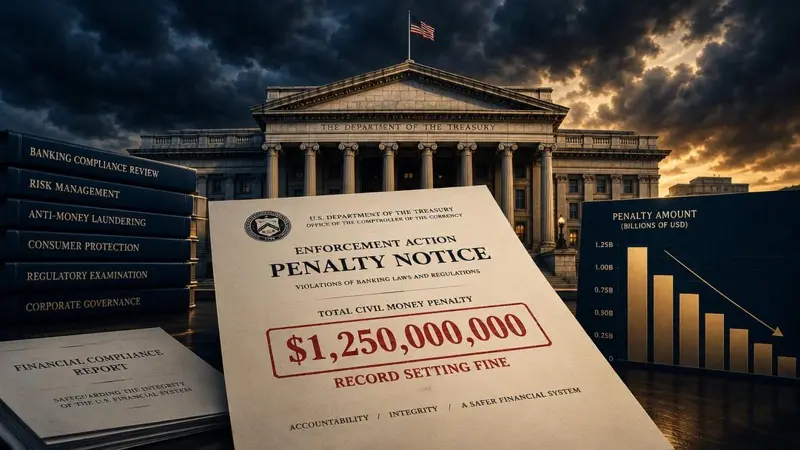
The U.S. Department of the Treasury announced a historic $1.2 billion penalty against Bank of America for serious Bank Secrecy Act violations, including failures to report more than $5 billion in suspicious transactions, weak transaction monitoring, and inadequate customer due diligence. Here is what went wrong, and what it means for banks, MSBs, and fintech companies.
The U.S. Department of the Treasury announced a historic $1.2 billion penalty against Bank of America for serious Bank Secrecy Act violations on October 13, 2026
The U.S. Department of the Treasury has announced a historic $1.2 billion penalty against Bank of America for serious violations of the Bank Secrecy Act (BSA), including failures to detect and report suspicious financial activity linked to national security risks.
The October 13, 2026, enforcement action highlights significant weaknesses in transaction monitoring, customer due diligence, Suspicious Activity Report (SAR) filings, and regulatory compliance oversight.
For banks, Money Services Businesses (MSBs), fintech companies, and other regulated financial institutions, this case delivers an important message: an AML compliance program must be effective in practice, not merely documented on paper.
Three agencies acted in coordination: FinCEN ($1.2B), the OCC ($750M, included within the BSA/AML resolution), and OFAC ($11.6M), totaling more than $1.21 billion
Bank of America Enforcement, Key Compliance Takeaways
- FinCEN imposed a $1.2 billion penalty for willful BSA violations, including failure to maintain an effective AML program and to file required SARs.
- The institution failed to timely report more than $5 billion in suspicious transactions, over $1 billion tied to national security and priority illicit finance risks.
- Regulators found ineffective transaction monitoring, reliance on external referrals, and customer due diligence weaknesses.
- The OCC flagged insufficient training and expertise among BSA personnel and a failing audit function.
- Significant problems remained unresolved after a December 2024 cease-and-desist order, a failure to remediate.
- The lesson for every regulated business: an AML program must be operational, risk-based, and effective, not merely written down.
Bank of America failed to timely report more than $5 billion in suspicious transactions, over $1 billion of which involved national security and priority illicit finance risks
More Than $1.21 Billion in Regulatory Penalties and Settlements
Three federal agencies announced coordinated enforcement actions against Bank of America:
- FinCEN: $1.2 billion penalty for willful BSA violations, including failures to maintain an effective AML program and file required SARs.
- Office of the Comptroller of the Currency (OCC): $750 million civil money penalty for significant deficiencies in its BSA/AML compliance program.
- Office of Foreign Assets Control (OFAC): $11.6 million settlement involving 475 apparent violations of U.S. sanctions programs.
The OCC penalty is included within the coordinated $1.2 billion BSA/AML resolution, rather than added to it. With the OFAC settlement, the total exceeds $1.21 billion.
According to Treasury, these actions include the third-largest penalty in Treasury history and the largest OCC penalty ever imposed.
Regulators found ineffective transaction monitoring, customer due diligence weaknesses, and reliance on external referrals to catch risks the bank should have detected itself
What Went Wrong at Bank of America?
The enforcement action describes a series of interconnected failures that regulators found across the institution's BSA/AML program. Each one reinforces the same theme: the program existed on paper, but it did not reliably work in practice.
The OCC identified insufficient BSA training and expertise and an audit function that failed to surface longstanding problems
1. Failure to Report Over $5 Billion in Suspicious Transactions
FinCEN determined that Bank of America failed to timely report more than $5 billion in suspicious transactions.
Over $1 billion involved potential national security and priority illicit finance risks, including activities associated with:
- Chinese money laundering networks.
- Potential narcotics trafficking along the southwest U.S. border.
- Fraud and trade-based money laundering.
- Other high-risk financial activity.
These transactions were identified as suspicious; that does not establish that every transaction involved criminal conduct.
The findings demonstrate how failures in transaction monitoring and SAR reporting can prevent law enforcement from receiving valuable financial intelligence. For the filing framework itself, see our guide to what triggers a SAR filing.
Significant deficiencies remained unresolved after a December 2024 OCC cease-and-desist order, a failure to remediate on top of the original findings
2. Ineffective Transaction Monitoring Systems
Regulators found that Bank of America's internal monitoring systems failed to identify and escalate significant suspicious activity.
The institution relied heavily on external sources, including law enforcement inquiries and referrals from other financial institutions, to identify risks that its own systems should have detected.
This raises a fundamental compliance concern: if your AML monitoring system cannot identify suspicious activity, how effective is your compliance program?
Financial institutions should regularly assess their monitoring rules, detection thresholds, data quality, and escalation procedures to ensure they remain appropriate for their risk exposure.
The core lesson for banks, MSBs, and fintechs: an AML program must be effective in practice, operational, risk-based, and independently tested, not merely documented on paper
3. Customer Due Diligence Weaknesses
FinCEN also identified deficiencies in the bank's customer due diligence processes.
Among the concerns were customer relationships involving substantial payments from unknown third parties and insufficient responses to indicators of potentially suspicious financial activity.
Effective CDD requires institutions to understand customer relationships, maintain appropriate risk profiles, and investigate activity inconsistent with expected behavior. For the underlying rule framework, see our customer due diligence explainer.
4. Inadequate Training and Independent Testing
The OCC identified insufficient expertise and training among key BSA compliance personnel.
The bank's audit function also failed to identify longstanding problems subsequently uncovered by regulators.
These findings demonstrate why employee training and independent AML testing are essential components of an effective compliance framework.
A compliance program cannot succeed when employees lack the knowledge, resources, or procedures necessary to recognize and escalate suspicious activity. See our overview of AML training and certification.
5. Failure to Correct Previously Identified Problems
Perhaps most concerning, Bank of America had already been subject to a December 2024 OCC cease-and-desist order addressing deficiencies in its AML compliance program.
Regulators found that significant problems remained unresolved.
This illustrates the importance of documenting compliance deficiencies, assigning corrective responsibilities, implementing remediation plans, and verifying that corrective measures actually work.
What This Means for Banks, MSBs, and Fintech Companies
Although Bank of America is one of the nation's largest financial institutions, the lessons apply to organizations of every size.
AML/BSA compliance obligations vary depending on an organization's activities and regulatory classification. Nevertheless, financial institutions subject to these requirements must implement programs appropriate to their risks and legal obligations.
Businesses should carefully evaluate five critical areas:
- Risk-Based AML Programs: Does your AML program reflect your actual customers, products, services, transaction activity, and geographic risks?
- Transaction Monitoring and SAR Reporting: Can your organization identify, investigate, escalate, and report suspicious activity within applicable regulatory deadlines?
- Customer Due Diligence: Are customer risk profiles appropriately maintained, with unusual activity investigated when necessary?
- Training and Independent Review: Are employees properly trained, and is your compliance program independently tested for effectiveness?
- Management Oversight and Remediation: Are identified deficiencies documented, corrected promptly, and reviewed to confirm that corrective actions are effective?
These questions are especially important for MSBs, payment processors, fintech platforms, and other businesses dealing with complex transactions or elevated financial crime risks. If you are unsure whether your business is covered, start with our MSB classification guide.
The Real Cost of AML Noncompliance
Financial penalties are only one consequence of an ineffective compliance program.
Regulatory enforcement may also result in mandatory remediation, independent reviews, increased supervisory scrutiny, operational disruption, and reputational harm.
In Bank of America's case, the FinCEN consent order requires a retrospective review of potentially unreported suspicious transactions and independent assessments of important AML controls.
For smaller institutions, the financial and operational impact of regulatory findings can be especially significant.
The cost of maintaining an effective AML compliance program is generally far more manageable than the consequences of serious regulatory violations.
How Soflo Consulting Helps Businesses Strengthen AML Compliance
At Soflo Consulting, we assist regulated businesses in developing practical, risk-based AML/BSA compliance frameworks aligned with their operations and applicable requirements.
Our services include:
- AML/BSA Compliance Training: Practical training to help personnel understand their responsibilities and recognize suspicious activity, see AML training and certification.
- AML Program Review: Evaluation of existing compliance policies, procedures, and controls to identify potential weaknesses, see how to build an AML program.
- AML Program Development: Creation of customized compliance documentation and frameworks based on the organization's business activities and regulatory obligations.
- Banking Partner Readiness: Additional consulting support for eligible clients preparing to address banking partner compliance expectations, see BSA risk assessment services.
Our objective is to help businesses build effective compliance practices, identify weaknesses early, and improve their regulatory preparedness.
Final Thoughts: Compliance Must Be More Than a Written Policy
The Bank of America enforcement action reinforces a fundamental principle of financial regulation:
Regulators expect financial institutions to demonstrate that their AML compliance programs are operational, risk-based, and effective.
Written policies, monitoring software, and annual training are important, but they must be supported by appropriate implementation, qualified personnel, independent testing, and management oversight.
For financial institutions, the most important question is not simply whether an AML program exists.
It is whether that program can effectively identify, manage, and address the organization's financial crime risks.
Is your AML compliance program prepared for regulatory scrutiny? Visit Soflo Consulting to learn how our AML/BSA training and consulting services can support your organization.
Disclaimer: This article is provided for informational and educational purposes only and does not constitute legal advice. Compliance obligations vary according to the applicable laws, regulations, and activities of each institution.
Frequently Asked Questions
Three federal agencies announced coordinated enforcement actions against Bank of America. FinCEN imposed a $1.2 billion penalty for willful Bank Secrecy Act violations, the Office of the Comptroller of the Currency imposed a $750 million civil money penalty for BSA/AML program deficiencies, and OFAC entered an $11.6 million settlement involving 475 apparent sanctions violations. The OCC penalty is included within the coordinated $1.2 billion BSA/AML resolution rather than added to it, so with the OFAC settlement the total exceeds $1.21 billion. According to Treasury, these include the third-largest penalty in Treasury history and the largest OCC penalty ever imposed.
What Is a Suspicious Activity Report (SAR)? The Complete Guide
Failures to file timely SARs were central to the Bank of America action, the complete guide to detecting, documenting, and filing suspicious activity.
What Is Customer Due Diligence (CDD)? The Plain-English Guide
FinCEN identified CDD weaknesses at Bank of America, the framework for understanding customers, maintaining risk profiles, and investigating unusual activity.

What Is an AML Program and Who Needs It in 2026?
The foundational overview of BSA/AML program requirements, including the training and independent testing elements the OCC found deficient.
BSA Modernization: What the New Proposed AML/CFT Rule Means for Financial Institutions
The proposed rule moves toward a formal effectiveness standard, directly relevant to the type of program failures this enforcement action exposes.
U.S. Treasury, Enforcement Actions Against Bank of America
The official Treasury announcement of the coordinated BSA/AML enforcement actions against Bank of America.
FinCEN, Bank of America Consent Order (PDF)
The FinCEN consent order detailing the willful BSA violations, the retrospective transaction review, and the independent control assessments.
FinCEN, Financial Crimes Enforcement Network
Primary source for BSA/AML rules, SAR filing guidance, and enforcement actions.
Tags
AML/BSA Compliance Insights Team · Soflo Consulting
Soflo Consulting Team publishes BSA/AML compliance analysis for regulated businesses across the United States. The team covers regulatory enforcement actions, FinCEN guidance, risk assessment, and emerging compliance obligations for banks, money services businesses, mortgage lenders, fintechs, and other covered institutions.
7 sections
Key Takeaways
- 1The U.S. Department of the Treasury announced a historic $1.2 billion penalty against Bank of America for serious Bank Secrecy Act violations on October 13, 2026
- 2Three agencies acted in coordination: FinCEN ($1.2B), the OCC ($750M, included within the BSA/AML resolution), and OFAC ($11.6M), totaling more than $1.21 billion
- 3Bank of America failed to timely report more than $5 billion in suspicious transactions, over $1 billion of which involved national security and priority illicit finance risks
- 4Regulators found ineffective transaction monitoring, customer due diligence weaknesses, and reliance on external referrals to catch risks the bank should have detected itself
- 5The OCC identified insufficient BSA training and expertise and an audit function that failed to surface longstanding problems
- 6Significant deficiencies remained unresolved after a December 2024 OCC cease-and-desist order, a failure to remediate on top of the original findings
- 7The core lesson for banks, MSBs, and fintechs: an AML program must be effective in practice, operational, risk-based, and independently tested, not merely documented on paper
Need Expert Guidance?
Put these insights into action. Talk to a compliance professional at Soflo Consulting compliance specialist.
Stay Ahead of Compliance
Get FinCEN updates, BSA/AML guidance, and federal compliance news delivered to your inbox - no fluff.