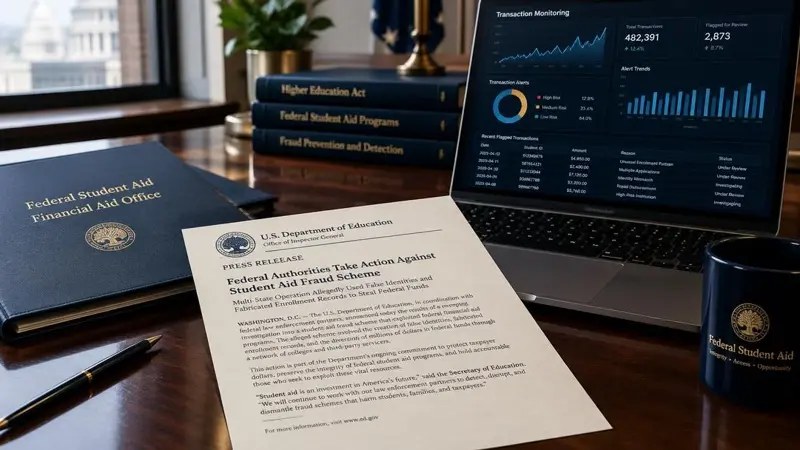
Treasury announced that FinCEN identified roughly $270 million in suspicious activity potentially linked to federal student aid fraud, with nearly 100 SARs filed and more than 20,000 transactions flagged since February 2026. Here is what the finding does and does not mean, and what covered institutions should review.
On October 19, 2026, Treasury announced that FinCEN identified approximately $270 million in suspicious activity potentially connected to federal student aid fraud
On October 19, 2026, the U.S. Department of the Treasury announced that the Financial Crimes Enforcement Network (FinCEN) had identified approximately $270 million in suspicious financial activity potentially connected to federal student aid fraud. The announcement follows FinCEN's July 2026 alert on the same schemes, and the wording matters: it describes suspicion, not proven fraud.
Nearly 100 SARs were filed after the July 2026 alert, and more than 20,000 potentially suspicious transactions were identified since February 2026, with referrals to federal law enforcement
What Treasury Announced
- Nearly 100 Suspicious Activity Reports (SARs) filed after the July 2026 alert.
- More than 20,000 potentially suspicious transactions identified since February 2026.
- Referrals to federal law enforcement for further investigation.
- Potential schemes involving ghost students, straw students, identity theft, synthetic identities, money mules, and shell companies.
- Approximately $270 million in suspicious activity potentially connected to student aid fraud.
FinCEN asks filers to use the key term FIN-2026-FSAFRAUD in SAR field 2 and the narrative, and to select SAR field 34(z) with the term "Federal Student Aid Fraud"
Primary source: U.S. Department of the Treasury, press release sb0663, October 19, 2026. Read the official announcement. The findings are Treasury's; the analysis is Soflo Consulting's.
Suspicious activity is not confirmed fraud: SAR data reflects reported suspicion, not adjudicated wrongdoing or verified losses
What the Numbers Do and Do Not Mean
A Suspicious Activity Report is exactly what its name says: a filing by an institution that has reason to suspect activity may be illegal, made after an internal investigation. Filing is not an accusation, and it is not a finding that a crime occurred. Suspicious activity is not confirmed fraud, and the $270 million reflects flagged activity, not an adjudicated loss figure.
The 20,000 figure reflects aggregated reporting data, not verified fraudulent payments. What the announcement does establish is that reporting volume is substantial and that FinCEN considered enough of it credible to refer matters to law enforcement.
Typologies include ghost students, straw students, identity theft, synthetic identities, money mules, and shell companies, all moving through ordinary ACH and banking channels
The Scheme Typologies Behind the Numbers
FinCEN's July alert described the mechanics, and the October announcement confirms those patterns are producing reporting volume.
Ghost students and identity theft
In a ghost student scheme, a fraudster uses stolen personal information, or a synthetic identity built from real and fabricated elements, to enroll someone who is not a real student. Refunds are issued, and the identity theft victim may later face tax consequences without knowing an account was opened in their name.
Straw students and money mules
A straw student is a real person who, for a fee, lets a fraudster enroll them and collect aid in their name. A refund lands and the balance leaves almost immediately for an unrelated account, with the holder keeping a small share. Networks repeat that pattern across many accounts.
Shell companies and layering
Proceeds are then layered through business accounts with little genuine activity and transfers structured to move value away from the originating account.
Refund deposits from educational institutions or intermediaries, followed by rapid outbound transfers, are the clearest monitoring signal
What Financial Institutions Should Know
Nothing in the announcement creates a new filing obligation. Bank Secrecy Act requirements, SAR rules, Customer Identification Program obligations, customer due diligence, and enhanced due diligence for higher-risk relationships continue to apply. What changes is calibration, because these schemes produce volume that generic rules may miss.
They move through ordinary channels because federal aid is disbursed through legitimate payment infrastructure. Refunds arrive by ACH from an institution or intermediary, often with "refund" and the institution's name in the reference. That is ordinary for millions of students. It becomes suspicious when it conflicts with the account's profile: a new account with no deposit history, a holder with no connection to the school, multiple refunds from different institutions, or a balance that exits within hours.
The announcement creates no new filing obligation, but it recalibrates how existing SAR, CIP, due diligence, and monitoring duties should be applied
Practical Compliance Considerations
The steps below are recommended practices, not new regulatory requirements.
- Review the applicable FinCEN alert and its red flags against current monitoring rules, and document the comparison.
- Identify unusual refund patterns, including deposits from institutions the customer has no documented relationship with.
- Monitor rapid movement of funds, particularly transfers that consume most of a refund balance shortly after it arrives.
- Investigate suspicious identity activity, including synthetic identity indicators that standard verification may miss.
- Evaluate monitoring rules and escalation procedures, and record any threshold changes.
- Document investigations so the reasoning behind a filing decision is reviewable.
- Update the AML risk assessment when exposure to benefits fraud has materially changed.
Keep two categories separate. Established obligations include SAR deadlines, CIP at account opening, due diligence and beneficial ownership collection for legal entity customers, and a risk-based program. Recommended practices include recalibrating rules, briefing investigators, and documenting the review.
A defensible response is a documented review: test whether your rules would surface these patterns, brief investigators, and record what you changed
What This Means for Your AML Compliance Program
Announcements like this read as a reporting story, but the lesson is about program design. An institution can hold a complete policy, deliver annual training, and file SARs on time while missing a scheme hidden inside ordinary ACH activity.
Four elements separate paper compliance from detection: a risk assessment that reflects your actual customers, monitoring calibrated to specific typologies, training that reaches front-line staff and investigators, and a documented escalation path from alert to recorded decision.
Soflo Consulting works with banks, money services businesses, mortgage companies, fintechs, and other covered institutions nationwide on these questions: building an AML program, completing a BSA/AML risk assessment, drafting policies and procedures, and delivering role-based AML training. The AML compliance checklist is a practical starting point.
A Measured Closing Note
The $270 million figure may grow as reporting continues. It remains a figure about suspicion rather than proof. The reasonable response is neither alarm nor complacency but a documented review: confirm whether these typologies apply to your customers, test whether your monitoring would surface them, and record what you found. To discuss your exposure, contact Soflo Consulting.
Disclaimer: This article is for general educational purposes only and is not legal or regulatory advice. It summarizes a public Treasury announcement and offers general commentary, and it does not allege wrongdoing by any person or institution. Consult qualified professionals about your specific circumstances.
Frequently Asked Questions
The U.S. Department of the Treasury announced that FinCEN identified approximately $270 million in suspicious financial activity potentially connected to federal student aid fraud. The announcement reported nearly 100 Suspicious Activity Reports filed following FinCEN's July 2026 alert, more than 20,000 potentially suspicious transactions identified since February 2026, and referrals to federal law enforcement for further investigation. It described potential schemes involving ghost students, straw students, identity theft, synthetic identities, money mules, and shell companies.
FinCEN Issues Alert on Fraud Schemes Targeting Federal Student Aid
The July 2026 alert that described ghost student, straw student, and money mule typologies in operational detail.
What Is a Suspicious Activity Report (SAR)? The Complete Guide
How filing decisions are made, what narratives should contain, and where confidentiality obligations apply.
What Is Customer Due Diligence (CDD)? The Plain-English Guide
The framework behind identity verification and ongoing monitoring for higher-risk relationships.

FinCEN Issues Joint Advisory on Non-Work Authorized Populations
A related 2026 benefits fraud advisory covering payroll and identity theft schemes with overlapping transaction patterns.
U.S. Department of the Treasury, press release sb0663 (October 19, 2026)
The official announcement of the approximately $270 million in suspicious student aid activity and related referrals.
FinCEN, news releases and announcements
Primary source for FinCEN alerts, advisories, and announcements referenced in this article.
FinCEN, official site
Primary source for BSA regulations, SAR filing guidance, and MSB registration information.
Tags
AML/BSA Compliance Insights Team · Soflo Consulting
Soflo Consulting Team publishes BSA/AML compliance analysis for regulated businesses across the United States. The team covers regulatory enforcement actions, FinCEN guidance, risk assessment, and emerging compliance obligations for banks, money services businesses, mortgage lenders, fintechs, and other covered institutions.
8 sections
Key Takeaways
- 1On October 19, 2026, Treasury announced that FinCEN identified approximately $270 million in suspicious activity potentially connected to federal student aid fraud
- 2Nearly 100 SARs were filed after the July 2026 alert, and more than 20,000 potentially suspicious transactions were identified since February 2026, with referrals to federal law enforcement
- 3FinCEN asks filers to use the key term FIN-2026-FSAFRAUD in SAR field 2 and the narrative, and to select SAR field 34(z) with the term "Federal Student Aid Fraud"
- 4Suspicious activity is not confirmed fraud: SAR data reflects reported suspicion, not adjudicated wrongdoing or verified losses
- 5Typologies include ghost students, straw students, identity theft, synthetic identities, money mules, and shell companies, all moving through ordinary ACH and banking channels
- 6Refund deposits from educational institutions or intermediaries, followed by rapid outbound transfers, are the clearest monitoring signal
- 7The announcement creates no new filing obligation, but it recalibrates how existing SAR, CIP, due diligence, and monitoring duties should be applied
- 8A defensible response is a documented review: test whether your rules would surface these patterns, brief investigators, and record what you changed
Need Expert Guidance?
Put these insights into action. Talk to a compliance professional at Soflo Consulting compliance specialist.
Stay Ahead of Compliance
Get FinCEN updates, BSA/AML guidance, and federal compliance news delivered to your inbox - no fluff.