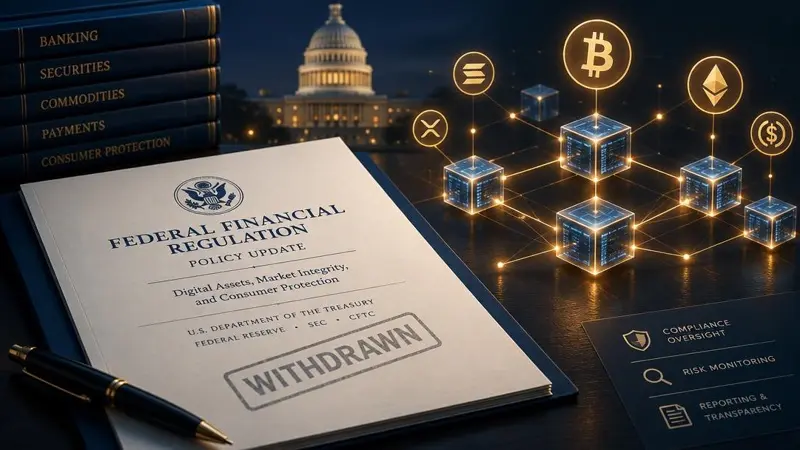
The CLARITY Act would reshape U.S. digital asset market structure, but it doesn't replace existing BSA, FinCEN, or OFAC AML obligations. Here's what crypto businesses need to review.
The CLARITY Act (H.R. 3633) is market-structure legislation, it is pending, has passed the House, but is NOT yet law
The Digital Asset Market Clarity Act, better known as the CLARITY Act (H.R. 3633), is federal legislation intended to clarify how digital assets are classified and which regulators oversee them. It addresses a long-running question about whether a given digital asset should be treated as a security, a commodity, or something else, and which agency, the SEC or the CFTC, has jurisdiction. As of this writing, the bill has not become law. It has passed the House of Representatives and advanced out of the Senate Banking Committee, but it has not passed the full Senate and has not been signed by the President. If enacted, it would primarily reshape digital asset market structure, not the separate anti-money-laundering obligations that many crypto, fintech, MSB, and money-transmitter businesses already have under the Bank Secrecy Act, FinCEN regulations, and OFAC sanctions rules. That distinction is the most important thing to understand, because a change in securities or commodities classification does not, by itself, resolve your BSA/AML obligations.
The bill would clarify digital asset classification and SEC vs. CFTC jurisdiction, but does not repeal or replace BSA, FinCEN, or OFAC obligations
CLARITY Act, Key Compliance Takeaways
- The legislation addresses the U.S. regulatory framework for digital assets, not AML/BSA obligations directly.
- It seeks greater clarity on digital asset classification and which regulator (SEC vs. CFTC) has jurisdiction.
- AML/BSA obligations may still apply independently, regardless of the bill's classification outcome.
- FinCEN requirements depend on the activity a business performs, not whether an asset is a "commodity" or "security."
- OFAC sanctions obligations remain a separate and important consideration.
- Crypto firms should review their regulatory classification, AML program, customer controls, transaction monitoring, and employee training.
Securities/commodities classification alone does not determine your AML obligations today, but Section 110 of the House-passed bill would extend BSA requirements to digital commodity brokers, dealers, and certain exchanges
What Is the CLARITY Act?
The CLARITY Act is a market-structure bill. Its core purpose is to draw a clearer line between digital assets that are treated as securities (generally under SEC oversight) and those treated as digital commodities (generally under CFTC oversight). The bill would define a "digital commodity", in the versions reported so far, as a digital asset whose value is intrinsically linked to the use of its underlying blockchain, and would allocate federal oversight of that asset accordingly. It would also create a framework for registering and regulating digital commodity exchanges, brokers, and dealers, and would provide a path for certain digital asset offerings to be offered and sold without traditional securities registration.
None of this changes the fact that digital asset market structure and anti-money-laundering obligations are related but separate regulatory issues. The CLARITY Act is fundamentally about who regulates the issuance and trading of digital assets. Your BSA/AML obligations, by contrast, are driven by the financial activity you perform, transmitting value, exchanging currency, holding customer funds, not by whether the asset you touch is classified as a commodity or a security.
FinCEN MSB and money transmitter obligations depend on the activity you perform, not on whether an asset is a "commodity" or "security"
What Is the Current Status of the CLARITY Act?
As of this writing, the CLARITY Act is pending legislation, it is not law. Its path to date:
- May 29, 2025, Introduced in the House of Representatives.
- July 17, 2025, Passed the House by a bipartisan vote of 294–134.
- September 18, 2025, Referred to the Senate.
- May 2026, A revised version advanced out of the Senate Banking Committee; reported to the full Senate on June 1, 2026.
- September 15, 2026, The Senate rejected cloture on the motion to proceed, 49-50 (Roll Call 234), and a motion to reconsider was entered.
Additional legislative steps remain before the bill could become law: passage by the full Senate, reconciliation of any differences between the House and Senate versions, and the President's signature. Until those steps are complete, the bill's provisions are proposals, not requirements. Businesses should monitor developments but should not treat the bill's provisions as currently effective law. Last reviewed: September 15, 2026.
Crypto businesses should review regulatory classification, AML program, KYC/CDD, transaction monitoring, OFAC controls, and employee training now
Who Could Be Affected by the CLARITY Act?
If enacted, the CLARITY Act could be relevant to a broad range of digital asset businesses, including cryptocurrency exchanges, digital asset trading platforms, brokers and dealers, custodians, token issuers, stablecoin-related businesses where applicable, blockchain companies, and DeFi-related businesses where applicable. It would also matter to fintech companies, payment companies, money services businesses (MSBs), and money transmitters whose products touch digital assets. The key point is that regulatory treatment depends on actual business activity, what you do, how you custody assets, and what role you play in a transaction, rather than a single label. Two businesses that both describe themselves as "crypto companies" can have materially different obligations.
OFAC sanctions obligations are separate from securities/commodities classification and remain important regardless of the bill's outcome
SEC vs. CFTC: How the CLARITY Act Addresses Jurisdiction
At a high level, the bill would reduce the ambiguity that has long surrounded the SEC/CFTC jurisdictional line. It would generally direct that digital assets meeting the "digital commodity" definition fall under CFTC oversight, while digital assets treated as securities remain within the SEC's framework. It would establish (or clarify) registration and oversight for digital commodity exchanges, brokers, and dealers, and would narrow the SEC's role with respect to certain digital commodity offerings. The legislation is detailed, and the precise contours depend on the final text, the Senate and House versions have differed, so the exact language that might become law is not yet fixed.
For compliance professionals, the most important caution is this: SEC or CFTC classification does not automatically resolve FinCEN, BSA, OFAC, or state licensing obligations. Those are separate frameworks with separate triggers. A digital asset that is ultimately treated as a commodity under the CLARITY Act does not become exempt from BSA/AML rules simply because of that classification, and a business that is "not a security" under SEC analysis can still be a money services business under FinCEN's rules.
Do not treat proposed or pending provisions as current requirements, but use this window to prepare and document your regulatory analysis
Does the CLARITY Act Change AML Requirements?
This is the single most consequential question for crypto and fintech businesses, and the short answer is: the CLARITY Act does not repeal or replace your existing AML/BSA obligations. The bill is mainly market-structure legislation, but it does address the Bank Secrecy Act. Section 110 of the House-passed version would add digital commodity brokers, dealers, and certain exchanges to the BSA's coverage, direct FinCEN to issue tailored requirements for AML/CFT programs, recordkeeping, suspicious activity reporting, and customer identification and due diligence, and require sanctions compliance. It does not eliminate FinCEN's authority. Businesses that are covered financial institutions today, under the BSA, FinCEN regulations, money services business rules, or state money transmitter laws, would generally remain subject to those obligations if the bill becomes law.
In practice, crypto and digital asset businesses may still have obligations relating to customer identification, customer due diligence, Suspicious Activity Reports (SARs), transaction monitoring, recordkeeping, OFAC sanctions screening, and state licensing laws. The precise set of requirements depends on your business model, not every crypto business has identical obligations, but the underlying frameworks do not disappear because a market-structure bill clarifies securities/commodities jurisdiction. If anything, the prudent assumption is that AML expectations continue to grow, not shrink.
FinCEN and Digital Asset Businesses
FinCEN administers the BSA and determines when a business falls within its money services business rules. The key question for a digital asset business is whether its activities constitute money transmission or currency exchange under FinCEN's framework, not whether its assets are "commodities" or "securities." Depending on the company's activities, a business that exchanges virtual currency for fiat, transmits virtual currency on behalf of customers, or acts as an intermediary may be a money transmitter and, therefore, an MSB. That triggers registration obligations with FinCEN (in most cases), an AML program, customer identification, transaction monitoring, recordkeeping, and SAR filing.
It would be a mistake to assume that all crypto businesses are automatically MSBs, a business that merely develops software, provides wallet hardware, or does not take control of customer funds may fall outside the money transmitter definition. But the classification is fact-specific. If you are unsure where your business sits, the right next step is a careful analysis of your actual activities against the BSA definitions, starting with the guide to MSB classification.
AML Program Checklist for Crypto Businesses
For businesses that are covered, a sound AML program typically includes the elements below. Requirements vary by business model, this is a framework to review against, not a universal mandate:
- A written AML/BSA policy approved at the appropriate governance level.
- A designated BSA/AML compliance officer.
- A business-wide risk assessment, updated as products and customers change, see our BSA/AML risk assessment service.
- Customer identification (KYC) and identity verification.
- Customer due diligence and beneficial ownership review where applicable.
- Transaction monitoring, including blockchain analytics.
- Suspicious activity escalation and documented SAR procedures.
- OFAC and wallet/address screening.
- Employee AML training, delivered and documented.
- Independent testing or review of the program.
- Recordkeeping and retention.
- A process for tracking regulatory and legislative updates.
- Documented governance and decision-making.
Crypto AML Red Flags
Compliance teams should recognize the following activity patterns as potential indicators of money laundering or other financial crime. They are warning signs to investigate, not proof of wrongdoing, and they should never be treated as a checklist for avoiding detection:
- Rapid movement of funds across multiple wallets in a short window.
- Transactions involving high-risk jurisdictions.
- Exposure to sanctioned or high-risk wallet addresses.
- Unusual mixing or tumbling activity.
- Chain-hopping, moving value across multiple blockchains.
- Unexplained third-party funding of a customer's activity.
- Activity inconsistent with the customer's stated profile.
- Rapid fiat-to-crypto-to-fiat movement.
- Shared identifiers (device, IP, email) across multiple accounts.
- Attempts to circumvent identity verification.
- Unusual transaction velocity or volume relative to the account.
- Suspicious or anomalous wallet behavior.
For a fuller treatment of industry-specific indicators, see our AML red flags by industry resource.
OFAC and Sanctions Compliance
Sanctions obligations are separate from securities and commodities classification and remain important regardless of what happens with the CLARITY Act. OFAC administers and enforces U.S. economic and trade sanctions, and its requirements apply broadly, including to many digital asset businesses. Practical controls typically include customer screening against the SDN and other sanctions lists, wallet and address screening, blockchain analytics to identify exposure to sanctioned actors or high-risk jurisdictions, escalation procedures for potential hits, and documented decisions. Where applicable, OFAC also has its own reporting channels, distinct from BSA SAR filing. A business can be fully compliant with securities or commodities rules and still face sanctions exposure if its screening is weak. See our explainer on the intersection of OFAC and AML.
KYC and Customer Due Diligence
For covered digital asset businesses, know-your-customer and customer due diligence obligations flow from the BSA/FinCEN framework, not from the CLARITY Act. In practice this means identity verification at onboarding, a risk-based approach to customer risk rating, source-of-funds considerations for higher-risk activity, beneficial ownership review where applicable, and ongoing monitoring. Higher-risk customers or relationships may warrant enhanced due diligence. The goal is a program where the depth of review is proportionate to the risk the customer presents, not a one-size-fits-all checkbox. See our guide to customer due diligence for the underlying rule framework.
Transaction Monitoring
Effective monitoring for digital asset businesses combines blockchain analytics with traditional fiat transaction monitoring. Teams should look at wallet exposure, transaction velocity, geographic risk, and behavioral anomalies that deviate from a customer's expected activity, and should calibrate monitoring thresholds to their own risk profile. Escalation procedures should be clearly documented so that an alert moves from detection to investigation to a documented disposition, without relying on manual heroics. The purpose of monitoring is to surface suspicious activity for review and, where warranted, reporting. It is not, and must not be, guidance for evading detection.
SAR Considerations
Suspicious activity escalation is a core part of a BSA/AML program. When monitoring surfaces activity that may indicate money laundering, fraud, or other financial crime, a covered institution should investigate, document its analysis, and reach a filing decision through a defined procedure. SAR confidentiality is strict, the existence of a SAR, and the fact that one may have been filed, must not be disclosed to the subject. Supporting documentation should be retained. It is equally important to understand that not every red flag requires a SAR: the filing decision follows from an investigation and the facts, not from the presence of a single indicator. For the complete filing framework, see what triggers a SAR.
AML Training for Crypto and Fintech Teams
Employee training is where compliance programs succeed or fail in practice, and crypto-specific training matters because the risks are unfamiliar to many staff. Effective crypto AML training should cover crypto-specific money laundering typologies, FinCEN requirements, customer identification, transaction monitoring, sanctions screening, suspicious activity recognition, escalation procedures, and emerging regulatory changes. It should be role-appropriate and delivered on a recurring basis, with new hires trained before they handle relevant activity.
Soflo Consulting provides AML/BSA training, including dedicated crypto AML training, fintech AML training, and MSB AML training, designed to help teams meet FinCEN expectations with content that is current, practical, and exam-ready. Investing in digital asset compliance training now positions your team to adapt as the regulatory landscape, including the CLARITY Act, continues to evolve.
What Crypto Businesses Should Do Now
You do not need to implement requirements that are not yet legally effective, but you should use this window to prepare. A practical action list:
- Identify your regulatory classification (security, commodity, money transmitter, or none).
- Determine whether MSB or money transmitter rules apply to your activity.
- Review federal and state licensing requirements.
- Update your AML risk assessment.
- Review your written AML policies and procedures.
- Review your KYC and CDD procedures.
- Test your transaction monitoring for calibration and coverage.
- Review your OFAC and sanctions controls.
- Update employee training.
- Document your regulatory analysis and conclusions.
- Monitor legislative and regulatory developments, including the CLARITY Act.
CLARITY Act vs. Existing AML Obligations
This comparison clarifies how multiple frameworks can apply simultaneously:
| Area | CLARITY Act / Market Structure | Existing AML/BSA Considerations |
|---|---|---|
| Regulatory classification | Digital commodity vs. security (proposed) | Money transmitter / MSB vs. non-MSB |
| SEC | Oversight of digital asset securities | Not the AML regulator; limited BSA role |
| CFTC | Oversight of digital commodities (proposed) | Not the AML regulator |
| FinCEN | Section 110 of the House-passed bill would direct FinCEN to issue tailored BSA rules for digital commodity intermediaries | Administers BSA; MSB registration and AML program rules |
| MSB registration | Section 109 would limit money transmitter treatment for certain non-controlling blockchain developers | Required for many money transmitters |
| AML program | Section 110 of the House-passed bill would require this for digital commodity brokers, dealers, and certain exchanges | Required for covered institutions |
| KYC | Section 110 of the House-passed bill would require this for digital commodity brokers, dealers, and certain exchanges | Required for covered institutions |
| Transaction monitoring | Section 110 of the House-passed bill would require this for digital commodity brokers, dealers, and certain exchanges | Required for covered institutions |
| SAR reporting | Section 110 of the House-passed bill would require this for digital commodity brokers, dealers, and certain exchanges | Required for covered institutions |
| OFAC | Section 110 of the House-passed bill would require this for digital commodity brokers, dealers, and certain exchanges | Applies broadly, separate from classification |
| State licensing | Check the current bill text | State money transmitter laws still apply |
| Employee training | Section 110 of the House-passed bill would require this for digital commodity brokers, dealers, and certain exchanges | Required element of an AML program |
Need Help Reviewing Your Crypto or Fintech AML Program?
The CLARITY Act is a market-structure development worth watching, but your AML obligations are driven by the activity you perform today, and those obligations are real now. Soflo Consulting can help you train your team, review your AML program, conduct a risk assessment, and build or review AML policies for compliance readiness. Contact Soflo Consulting to discuss your specific situation.
Disclaimer: This article is provided for general educational and informational purposes only and is not legal, financial, or regulatory advice. It does not create an attorney-client or consultant-client relationship. Regulatory requirements vary by business model and jurisdiction, and laws change frequently. Consult qualified legal and compliance professionals regarding your specific circumstances.
Frequently Asked Questions
The Digital Asset Market Clarity Act (the CLARITY Act, H.R. 3633) is federal legislation intended to clarify how digital assets are classified and which regulator, the SEC or the CFTC, has jurisdiction. It would generally direct that digital assets meeting its "digital commodity" definition fall under CFTC oversight, while digital asset securities remain within the SEC framework, and it would establish a framework for digital commodity exchanges, brokers, and dealers. It is market-structure legislation, not an AML/BSA bill.

Crypto Exchange AML Obligations: The Complete 2024 Breakdown
The activity-based analysis of when a crypto exchange is a money transmitter and what BSA/AML obligations follow.

What Is an MSB? The Money Services Business Classification Guide
The plain-English guide to FinCEN's MSB and money transmitter definitions, the starting point for any crypto business classification question.
OFAC Sanctions Compliance and AML: Understanding the Intersection
How OFAC screening overlaps with, and remains distinct from, your BSA/AML obligations.

What Is an AML Program and Who Needs It in 2026?
The foundational overview of BSA/AML program requirements and how to tell whether your business is covered.
Congress.gov, H.R. 3633, Digital Asset Market Clarity Act (all actions and text)
The authoritative source for the bill's current status, text, and legislative actions.
FinCEN, Financial Crimes Enforcement Network
Primary source for BSA/AML rules, MSB registration, and digital asset guidance.
OFAC, Office of Foreign Assets Control
Primary source for U.S. sanctions programs and screening requirements.
SEC, Digital Asset Hub
Primary source for the SEC's treatment of digital asset securities.
CFTC, Digital Assets
Primary source for the CFTC's treatment of digital commodities.
U.S. Department of the Treasury
Primary source for Treasury policy on digital assets and financial integrity.
Tags
AML/BSA Compliance Insights Team · Soflo Consulting
Soflo Consulting Team publishes BSA/AML compliance analysis for regulated businesses across the United States. The team covers regulatory enforcement actions, FinCEN guidance, risk assessment, and emerging compliance obligations for banks, money services businesses, mortgage lenders, fintechs, and other covered institutions.
7 sections
Key Takeaways
- 1The CLARITY Act (H.R. 3633) is market-structure legislation, it is pending, has passed the House, but is NOT yet law
- 2The bill would clarify digital asset classification and SEC vs. CFTC jurisdiction, but does not repeal or replace BSA, FinCEN, or OFAC obligations
- 3Securities/commodities classification alone does not determine your AML obligations today, but Section 110 of the House-passed bill would extend BSA requirements to digital commodity brokers, dealers, and certain exchanges
- 4FinCEN MSB and money transmitter obligations depend on the activity you perform, not on whether an asset is a "commodity" or "security"
- 5Crypto businesses should review regulatory classification, AML program, KYC/CDD, transaction monitoring, OFAC controls, and employee training now
- 6OFAC sanctions obligations are separate from securities/commodities classification and remain important regardless of the bill's outcome
- 7Do not treat proposed or pending provisions as current requirements, but use this window to prepare and document your regulatory analysis
Need Expert Guidance?
Put these insights into action. Talk to a compliance professional at Soflo Consulting compliance specialist.
Stay Ahead of Compliance
Get FinCEN updates, BSA/AML guidance, and federal compliance news delivered to your inbox - no fluff.