FinCEN's Operation Economic Outcast convened global financial institutions on Iranian illicit finance. Here is what the FinCEN Exchange means for AML, OFAC screening, transaction monitoring, and training.
The September 16, 2026 FinCEN Exchange is a voluntary information-sharing session, not a new regulation
On September 16, 2026, the U.S. Department of the Treasury's Financial Crimes Enforcement Network (FinCEN) convened a FinCEN Exchange involving global financial institutions as part of Operation Economic Outcast. According to FinCEN, the initiative is intended to improve public-private information sharing related to Iranian revenue streams, procurement networks, financial facilitators and intermediaries, money laundering, access to U.S. correspondent banking relationships, weapons procurement, and terrorist financing, including networks involving Iran, its proxies, and facilitators.
Sanctions compliance cannot be reduced to matching names against the OFAC list
Those descriptions are FinCEN's and Treasury's, not Soflo Consulting's characterization. Our purpose here is narrower and more practical: to help compliance teams understand what a development like this means for their BSA/AML programs, their sanctions and OFAC screening, their transaction monitoring, and their AML training. The significance extends well beyond a single country or a single sanctions program. The underlying lesson is that financial institutions need systems capable of identifying networks, intermediaries, unusual transaction patterns, sanctions exposure, and changing geopolitical financial-crime risks, not simply matching customer names against a sanctions list.
Networks, intermediaries, beneficial ownership, and behavior matter as much as list screening
Key Takeaways
- The September 16, 2026 FinCEN Exchange is a voluntary public-private information-sharing session, not a new regulation, it does not by itself impose new obligations on any institution.
- The practical lesson is that sanctions compliance cannot be reduced to "is this name on the OFAC list?", networks, intermediaries, and behavior matter.
- The announcement is most relevant to institutions with cross-border exposure, correspondent relationships, or higher-risk counterparties.
- Red flags are indicators for review, not proof of wrongdoing or a sanctions violation.
- Institutions should consider reviewing, not automatically overhaul, their risk assessment, monitoring, and training in light of the announcement.
- Alert value depends on training: employees must understand how regulatory developments connect to their daily responsibilities.
MSBs and fintechs are exposed even when they never deal directly with a sanctioned person
What Is Operation Economic Outcast?
Operation Economic Outcast is a Treasury-led effort that, per FinCEN, uses a combination of financial intelligence, sanctions, AML reporting, private-sector cooperation, law-enforcement information, and FinCEN alerts and advisories to identify and disrupt illicit financial networks connected to Iran. The initiative is best understood as a coordination and information-sharing campaign rather than a single new rule.
Red flags are indicators for review, not proof of criminal activity or a sanctions violation
It is important to keep two things separate. First, there is the government's intelligence-sharing initiative, the strategic effort to detect and dismantle networks. Second, there are the specific regulatory obligations that apply to any individual financial institution under existing BSA/AML and OFAC requirements. An announcement about the former does not, on its own, create the latter. Institutions should read the announcement as a signal about where enforcement attention and information-sharing emphasis may be directed, not as a checklist of new mandates.
The right response to a new alert is a risk-based review, not a reactionary overhaul
Why the FinCEN Exchange Matters
The FinCEN Exchange program is a statutorily authorized, voluntary public-private partnership that brings together law enforcement, FinCEN, financial institutions, and other relevant stakeholders. Its purpose is to share information that helps financial institutions identify and report financial crime more effectively.
Alert value depends on training that connects developments to each employee's daily role
Information sharing matters because a single suspicious transaction often looks ordinary when viewed through the lens of one institution. Patterns become more apparent when investigators can see across multiple institutions, intermediaries, related companies, payment corridors, beneficial owners, shipping companies, trading companies, procurement businesses, digital assets, correspondent banking, and repeated counterparties. Consider a simple example: a newly formed trading company in one jurisdiction sends a series of payments to a supplier in a second jurisdiction, which in turn routes funds through an intermediary bank in a third. No single institution in that chain may see anything alarming. But viewed together, the activity may warrant a closer look. This is the value the FinCEN Exchange is designed to deliver, and it is also, in miniature, the reason your own transaction monitoring and due diligence need to consider the full picture, not just isolated transactions.
The Compliance Lesson: Look Beyond the Sanctions List
This is the most important takeaway for compliance teams. Sanctions compliance cannot be reduced to asking, "Is this customer on the OFAC list?" Institutions should consider broader indicators, including ownership and control, beneficial ownership, intermediaries, front or shell companies, geographic exposure, payment corridors, unusual third-party payments, changes in transaction behavior, high-risk counterparties, trade activity inconsistent with the customer profile, layered payments, rapid movement of funds, unexplained international transfers, and possible sanctions-evasion structures.
None of these indicators alone establishes that illicit activity has occurred. Context matters. A business with legitimate cross-border trade will naturally have many of these characteristics. The point is not to treat these factors as proof of wrongdoing, but as signals that should trigger a deeper, documented review. A strong program knows how to distinguish a red flag that warrants escalation from a red flag that resolves into an ordinary, explainable transaction.
Why This Matters for MSBs and Fintechs
Soflo Consulting works extensively with money services businesses (MSBs), fintechs, and payment companies, and this is precisely the audience that should pay close attention. These businesses often sit in the cross-border flow of funds, and their vulnerabilities can include cross-border payments, remittances, payment aggregation, digital wallets, payment processors, foreign counterparties, nested payment relationships, multiple intermediaries, higher-risk jurisdictions, and rapid movement of funds.
The key insight is that an MSB may never deal directly with a sanctioned person and still encounter transactions involving intermediaries or counterparties connected to higher-risk networks. This is why effective compliance depends on understanding five things together: customer + counterparty + geography + transaction behavior + purpose of payment. A single leg of that equation rarely tells the full story. For fintechs and payment companies in particular, see our guidance on fintech AML/BSA compliance.
Correspondent Banking Risk
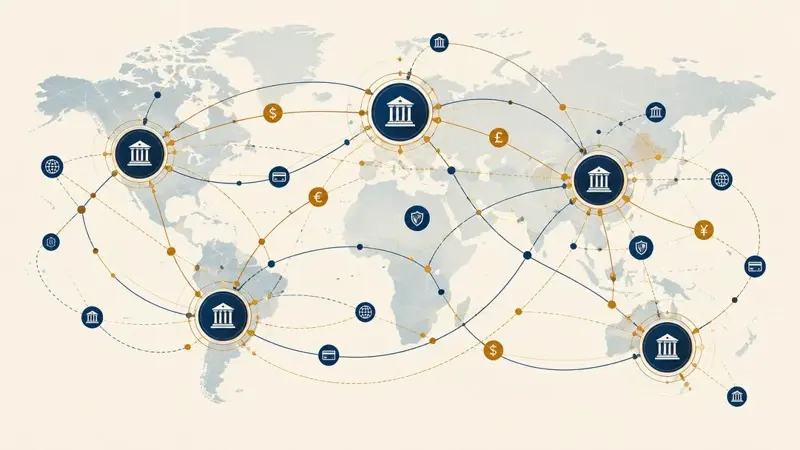
FinCEN's reference to networks potentially obtaining access to U.S. correspondent banking relationships is significant. In plain terms, correspondent banking is the arrangement where one bank holds deposits or processes payments on behalf of another bank, allowing transactions to reach institutions and jurisdictions where the originating bank has no direct presence. An international payment can therefore pass through multiple institutions before it reaches the ultimate beneficiary.
Potential controls to review include counterparty due diligence, geographic risk, nested relationships, payment transparency, originator and beneficiary information, unusual routing, repeated intermediary institutions, and sanctions screening. It is important not to imply that all correspondent banking is high risk or suspicious, the vast majority of correspondent activity is entirely legitimate. The point is that institutions participating in these chains should understand who their counterparties are and whether the payment flows make sense.
Procurement Networks Can Look Like Ordinary Commerce
One of the hardest challenges with procurement-related financial crime is that transactions may initially resemble legitimate commercial payments. The activity FinCEN describes can involve aviation parts, electronics, industrial equipment, technology, logistics, shipping, trading companies, brokers, and import/export businesses, all of which are also normal, legitimate industries.
Compliance teams should therefore consider whether activity makes sense for the customer's business, whether transaction sizes are consistent with the expected profile, whether counterparties make economic sense, whether the jurisdictions involved are expected, whether payment descriptions correspond with the business, and whether newly formed entities suddenly receive significant international payments. Again, none of these characteristics themselves indicate wrongdoing. They are prompts to ask questions and, where answers are unsatisfying, to document the review.
Transaction Monitoring Should Be Risk-Based
This announcement is a useful opportunity to review monitoring scenarios. Potential risk indicators to consider include repeated international wires inconsistent with expected activity, rapid movement of funds through multiple accounts, payments involving multiple unrelated intermediaries, unexpected higher-risk jurisdictions, sudden changes in counterparties, newly created companies receiving large international payments, multiple entities sharing addresses or contact information, unexplained third-party payments, and transactions inconsistent with stated business activity.
Red flags are indicators for additional review, not proof of criminal activity or sanctions violations.
A well-designed monitoring program calibrates scenarios to the institution's actual risk profile rather than generating noise. For more on building that discipline, see our article on compliance monitoring.
KYC and Enhanced Due Diligence Matter
Good customer due diligence establishes the baseline against which unusual activity is detected later. Institutions should understand the nature and purpose of the customer relationship, expected transaction activity, ownership structure, beneficial owners, geographic exposure, products and services, expected counterparties, and, where appropriate, the source of funds. Without this baseline, transaction monitoring is largely guesswork: you cannot identify "unusual" if you do not know what "usual" looks like for that customer.
Where a customer or relationship presents heightened risk, whether because of geography, product type, ownership complexity, or transaction patterns, a risk-based Enhanced Due Diligence (EDD) approach may be appropriate. EDD is not a universal requirement applied identically to every customer; it is a risk-based judgment about which relationships warrant a deeper look.
OFAC Screening Is Necessary, but It Is Not the Entire AML Program
It is useful to distinguish two different controls that are often conflated. Sanctions screening checks parties and transactions against applicable sanctions restrictions, the OFAC SDN list and other sanctions lists. AML transaction monitoring evaluates behavior and transactions for potentially suspicious activity. They are related but not interchangeable: a customer can clear sanctions screening and still warrant a suspicious-activity review, and a sanctions "hit" is a separate legal question from whether a SAR should be filed.
A complete program considers customer screening, beneficial-owner screening, counterparty screening, transaction screening, ongoing monitoring, list updates, and escalation procedures. Because specific obligations vary with an institution's regulatory status, we avoid making absolute statements that apply uniformly to everyone, but the principle holds across the board: OFAC screening and AML monitoring are complementary, not synonymous.
Review FinCEN Alerts Together, Not in Isolation
This announcement connects to FinCEN's broader Iran-related guidance and alerts, and compliance teams should consider regulatory communications collectively rather than treating each alert as an isolated event. The relevant categories span procurement networks, aviation-related procurement, sanctions evasion, terrorist financing, money laundering, digital assets where applicable, and cross-border financial activity.
Reading the alerts together reveals a pattern, a sustained emphasis on networks, intermediaries, and evasion techniques, that a single alert viewed alone does not. Always use official FinCEN and OFAC resources as the authoritative source, and use third-party commentary (including this article) only as a lens for understanding, never as a substitute for the primary guidance.
What Compliance Teams Should Consider Reviewing Now
The following is a practical checklist, framed as "consider reviewing" because not every item is legally required for every institution:
- Review recent FinCEN Iran-related alerts and advisories.
- Review applicable OFAC sanctions updates.
- Confirm sanctions-screening systems are current.
- Review geographic risk assessments.
- Review higher-risk customer and counterparty relationships.
- Evaluate relevant transaction-monitoring scenarios.
- Review escalation procedures.
- Confirm investigators understand the difference between a red flag and a conclusion.
- Review SAR decision-making and documentation procedures.
- Determine whether employees need updated AML and sanctions training.
- Document material changes to the institution's risk environment.
- Determine whether the AML risk assessment should be updated.
The Training Issue
Regulatory alerts have limited value if employees do not understand how they relate to their daily responsibilities. This is where AML training becomes essential, not as a one-time checkbox, but as the mechanism that translates regulatory developments into action at every level of the organization.
Different employees need different training. Front-line employees should know when activity should be escalated. Operations teams should understand unusual payment behavior. Compliance analysts should recognize potentially relevant transaction patterns. BSA/AML Officers should understand regulatory developments and determine whether policies, monitoring, or risk assessments require review. Senior management should understand the material financial-crime risks facing the organization. A well-designed BSA/AML training program, including appropriate OFAC training, tailors content to each of these audiences rather than delivering the same generic module to everyone. For institutions that move money across borders, targeted MSB AML training and fintech AML training should reflect the specific payment-corridor and intermediary risks those businesses face.
A Risk-Based Approach Is Better Than a Reactionary Approach
Organizations should not automatically terminate customers, block transactions, classify customers as suspicious, or radically alter policies simply because a new government alert is published. The disciplined question is narrower: Does this development materially change our institution's risk exposure?
That evaluation should consider customer base, geographic exposure, products, services, payment corridors, transaction volumes, correspondent relationships, and counterparties. If the answer is yes, determine whether changes to controls, monitoring, training, EDD, or the risk assessment are appropriate. This reflects a conservative but practical compliance philosophy: understand the risk, document the analysis, adjust controls when warranted, and train the people responsible for identifying the risk. A BSA/AML risk assessment is the right place to document that analysis.
Questions BSA/AML Officers Should Be Asking
- Do we have customers or counterparties operating in industries referenced by recent FinCEN alerts?
- Do we understand our international payment corridors?
- Are beneficial owners appropriately identified?
- Are sanctions-screening systems current?
- Do our monitoring scenarios identify activity inconsistent with customer profiles?
- Are investigators familiar with current FinCEN guidance?
- Do escalation procedures clearly explain when activity should be referred to compliance?
- Does this development require an update to our AML risk assessment?
- Have relevant employees received current AML and OFAC training?
Final Takeaway
The core lesson is straightforward: financial crime compliance increasingly requires understanding networks, transactions, and behavior, not simply checking names against lists. Operation Economic Outcast demonstrates Treasury and FinCEN's continued emphasis on information sharing between government and the private financial sector, and it signals where attention is being focused. Financial institutions should evaluate whether these developments are relevant to their own risk profile and adjust their risk-based programs when appropriate, through monitoring, due diligence, policy, and training, rather than reacting reflexively.
How Soflo Consulting Can Help
Is your AML program keeping up with emerging financial-crime risks?
Soflo Consulting helps financial institutions, MSBs, fintechs, mortgage companies, and other regulated businesses strengthen their compliance programs through AML training, BSA/AML and OFAC training, AML risk assessments, AML policy review, AML policy development, compliance program reviews, and KYC/EDD guidance.
Disclaimer: This article is provided for general informational and educational purposes and does not constitute legal advice. Organizations should evaluate regulatory guidance based on their specific activities, risk profile, and applicable legal and regulatory requirements. Soflo Consulting does not provide legal advice and does not guarantee regulatory compliance.
Frequently Asked Questions
Operation Economic Outcast is a Treasury-led initiative that, according to FinCEN, uses financial intelligence, sanctions, AML reporting, private-sector cooperation, law-enforcement information, and FinCEN alerts to identify and disrupt illicit financial networks connected to Iran. It is best understood as an information-sharing and coordination campaign rather than a single new rule.
OFAC Sanctions Compliance and AML: Understanding the Intersection
How OFAC screening overlaps with, and remains distinct from, BSA/AML obligations.

Compliance Monitoring for Financial Institutions, MSBs, and Fintechs
How to build transaction monitoring and testing that fits your actual risk profile.

What Should an AML Policy Review Include?
The policy layer that turns regulatory developments into documented procedures.
FinCEN, Treasury Convenes Global Financial Institutions to Advance Operation Economic Outcast
The official September 16, 2026 FinCEN announcement that this article discusses.
FinCEN, FinCEN Exchange
Overview of the voluntary public-private information-sharing program.
OFAC, Sanctions Programs and Information
Authoritative source for U.S. sanctions programs, including Iran-related restrictions.
FinCEN, Advisories and Bulletins
Official repository of FinCEN alerts, advisories, and guidance.
Tags
AML/BSA Compliance Insights Team · Soflo Consulting
Soflo Consulting Team publishes BSA/AML compliance analysis for regulated businesses across the United States. The team covers regulatory enforcement actions, FinCEN guidance, risk assessment, and emerging compliance obligations for banks, money services businesses, mortgage lenders, fintechs, and other covered institutions.
7 sections
Key Takeaways
- 1The September 16, 2026 FinCEN Exchange is a voluntary information-sharing session, not a new regulation
- 2Sanctions compliance cannot be reduced to matching names against the OFAC list
- 3Networks, intermediaries, beneficial ownership, and behavior matter as much as list screening
- 4MSBs and fintechs are exposed even when they never deal directly with a sanctioned person
- 5Red flags are indicators for review, not proof of criminal activity or a sanctions violation
- 6The right response to a new alert is a risk-based review, not a reactionary overhaul
- 7Alert value depends on training that connects developments to each employee's daily role
Need Expert Guidance?
Put these insights into action. Talk to a compliance professional at Soflo Consulting compliance specialist.
Stay Ahead of Compliance
Get FinCEN updates, BSA/AML guidance, and federal compliance news delivered to your inbox - no fluff.