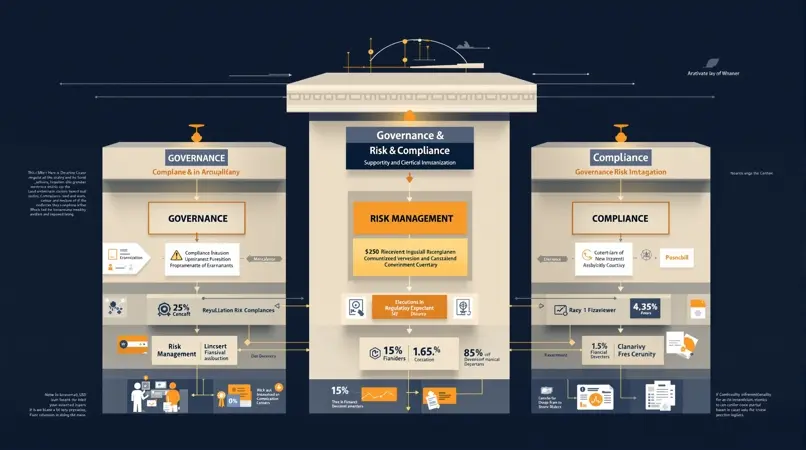
Governance, risk, and compliance (GRC) is the framework organizations use to operate responsibly, and AML/BSA is one critical component of it. Here's how they connect.
Governance is oversight and accountability; risk management is identifying and mitigating risk; compliance is following the rules
Governance, risk, and compliance (GRC) are three disciplines that, together, describe how an organization is directed, how it identifies and manages uncertainty, and how it meets its legal and ethical obligations. Governance is the system of leadership, oversight, and accountability that sets direction and tone from the top. Risk management is the disciplined process of identifying, assessing, and mitigating the risks that could threaten the organization's objectives. Compliance is the work of ensuring the organization actually follows the laws, rules, and internal policies that apply to it. None of the three works well in isolation: strong governance without effective risk management is blind; risk management without compliance is unaccountable; and compliance without governance has no authority. For financial institutions, MSBs, and fintechs, AML/BSA compliance is one important component of this broader structure, not a standalone function, but a discipline that lives inside the risk and compliance framework.
AML/BSA is one critical component of a broader governance, risk, and compliance framework, not a standalone silo
GRC & AML, Key Takeaways
- Governance is oversight and accountability; risk management is identifying and mitigating risk; compliance is following the rules.
- AML/BSA is one component of the broader GRC structure, it does not replace it, and it cannot succeed without it.
- A risk assessment is the foundation: you cannot manage risk you have not identified and measured.
- Software supports compliance, it does not replace risk assessments, policies, training, human review, or regulatory judgment.
- Strong programs are documented, tested, and overseen by the board and senior management.
- Requirements vary by business model, GRC is a framework to adapt, not a template to copy blindly.
The AML risk assessment is the foundation: you cannot manage risk you have not identified and measured
What Does GRC Mean?
GRC compliance is shorthand for the integrated way mature organizations manage three overlapping responsibilities. The term "GRC" emerged from the recognition that governance, risk, and compliance are deeply interrelated and are most effective when treated as a coordinated whole rather than as separate silos. In practice, a governance risk compliance program brings together the board and management structures that set direction, the risk functions that assess exposure, and the compliance functions that translate obligations into controls. For a financial institution, this framework is not optional window dressing, it is the mechanism by which the organization stays safe, solvent, and in good standing with regulators.
The key insight is that these disciplines reinforce one another. Governance provides the authority and accountability that give risk management and compliance their teeth. Risk management tells governance where the real dangers are. Compliance ensures that risk decisions and oversight activities are themselves conducted within the law. A breakdown in any one pillar tends to cascade into the others.
Software supports compliance but does not replace risk assessments, policies, training, human review, or regulatory judgment
Governance Explained
Governance is the system of rules, roles, and relationships through which an organization is directed and controlled. It answers the question, who is accountable, and how are decisions made? At the top sits the board of directors and senior management, who set the organization's risk appetite, approve key policies, and hold leadership accountable. Effective governance establishes clear reporting lines, defined roles and responsibilities, and a "tone from the top" that signals compliance is a priority, not an afterthought. When governance is weak, even well-designed controls tend to fail, because no one is ultimately responsible for making them work.
Board and senior management oversight is what gives the rest of the framework its authority and accountability
Risk Management Explained
Risk management is the systematic process of identifying, assessing, monitoring, and mitigating the risks that could prevent an organization from achieving its objectives. It begins with a risk assessment, an honest inventory of where the organization is exposed and how severe that exposure is, and continues with the design of controls proportionate to that risk. Risk management is inherently risk-based rather than one-size-fits-all: an organization directs its finite resources toward the risks that matter most. Within financial services, AML risk management is the application of this same discipline to the specific risks of money laundering, terrorist financing, and sanctions evasion.
Documentation, testing, and independent review are what make a program real, repeatable, and defensible
Compliance Explained
Compliance is the function that ensures the organization meets its legal, regulatory, and ethical obligations, and its own internal policies. It translates abstract legal requirements into concrete procedures, trains employees to follow them, monitors adherence, and reports on the results. A compliance framework is the structured set of policies, procedures, controls, and oversight activities that makes compliance repeatable and demonstrable. Crucially, compliance is not simply "not breaking the law"; it is the affirmative, documented effort to operate within a complex web of rules that change constantly.
Requirements vary by business model, GRC is a framework to adapt, not a template to copy blindly
Where AML/BSA Fits into GRC
Anti-money laundering and Bank Secrecy Act obligations sit squarely inside the GRC framework. AML governance means the board and senior management oversee the AML program, approve policy, and designate a qualified compliance officer. AML risk management means the organization conducts an AML risk assessment, then builds controls proportionate to that risk. AML compliance means the organization maintains the policies, training, monitoring, and independent testing the BSA and FinCEN's rules expect. In other words, AML is not a separate universe from GRC, it is one of the most heavily regulated applications of it. A financial institution that treats AML as an isolated, tick-the-box exercise, disconnected from its broader governance and risk framework, is usually an institution with weak AML.
This is why financial services GRC programs that succeed tend to embed AML within them rather than bolt it on. The risk assessment, the policy review, the training, and the oversight that GRC demands are exactly the activities a sound AML program requires. For the foundational requirements, see our overview of FinCEN AML program requirements.
AML Risk Assessments
The AML risk assessment is where GRC and AML meet most directly. It is the process of identifying the specific money-laundering, terrorist-financing, and sanctions risks an institution faces, based on its customers, products, services, and geographies, and assessing both the likelihood and the impact of each. The result is a prioritized view of risk that tells the organization where to allocate its compliance resources. A risk assessment is not a one-time deliverable; it should be refreshed periodically and whenever the business, its customer base, or the regulatory environment changes materially. Without it, a compliance program is guessing. See our guide to conducting an AML risk assessment.
Policies and Procedures
Governance sets direction; policies and procedures turn it into action. A written AML policy documents the organization's commitment, its risk appetite, and the framework of controls it will maintain. Procedures go a step further, specifying exactly how each control is executed and by whom. The discipline here matters: policies that are never reviewed drift out of alignment with both the law and the business, and procedures that are never tested may not reflect what actually happens. A regular AML policy review is how an organization keeps its documented program honest. For help building or refreshing yours, see our AML policy creation service.
Employee Training
Policies mean nothing if employees do not understand or follow them. Training is the bridge between documentation and behavior, it is how a board-level commitment becomes something every employee acts on. Effective AML training should be role-based, ongoing, and connected to the specific risks and typologies employees are likely to encounter. It is also a regulatory expectation: a documented training program is a standard element of a sound BSA/AML program. Training is not a one-and-done annual box to tick; it is a continuous investment in the human layer of the compliance framework.
Transaction Monitoring
Risk management requires visibility, and for financial institutions that visibility comes largely through transaction monitoring, the review of payments, transfers, and customer activity for patterns that may indicate money laundering or other financial crime. Transaction monitoring is the operational core of an AML program, and it is where risk-based calibration matters most: thresholds and rules should reflect the institution's own risk profile, not be copied from another organization. For a complete treatment of the discipline, see our article on compliance monitoring.
Compliance Testing
A control that is never tested is a control you cannot prove works. Compliance testing, including the independent testing of an AML program, verifies that policies are being followed, controls are operating as designed, and the program is actually effective rather than merely documented. Independent testing is distinct from day-to-day monitoring: it is a periodic, objective evaluation of the program as a whole. This is one of the clearest places where software cannot substitute for human oversight and judgment. A tool can flag exceptions; it cannot judge whether the program itself is sound.
Board and Management Oversight
Governance is only real if it reaches the top. The board and senior management are expected to be informed about the AML program, to approve policy, to receive reporting on its effectiveness, and to provide adequate resources. This is the "tone from the top" that examiners consistently emphasize. Oversight is not ceremonial; it is the accountability mechanism that makes the rest of the framework meaningful. When an AML program fails, a recurring theme in enforcement actions is a board that was not meaningfully engaged.
Documentation
Across every pillar of GRC, documentation is what makes the work real, repeatable, and defensible. Risk assessments, policy approvals, training records, monitoring decisions, escalation decisions, and independent testing results should all be documented and retained. Documentation serves three purposes: it forces rigor (you have to be able to write down what you did and why), it creates continuity (the program survives staff turnover), and it provides evidence (you can demonstrate to an examiner that your program is genuinely effective). A program that exists only in someone's head is not a program.
GRC Software vs. Human Compliance Oversight
A common misconception is that buying a GRC or AML software platform solves compliance. It does not, and Soflo Consulting is deliberately not a software vendor. Software can support compliance by organizing policies, automating screening, generating alerts, and storing documentation. But it cannot replace the judgment-heavy work that constitutes real compliance: conducting a thoughtful risk assessment, writing policies that fit the business, training employees to recognize risk, performing human review of alerts, conducting independent testing, and exercising the regulatory judgment that turns raw data into sound decisions. A tool can surface a red flag; only a trained person can decide what it means and what to do about it. The strongest programs pair good tools with strong human oversight, they never confuse one for the other.
Common GRC Mistakes
Most GRC failures trace to a handful of recurring patterns. Treating governance as a formality rather than real accountability; conducting a risk assessment once and never updating it; letting policies and procedures drift out of alignment with the business; treating training as an annual box to tick; buying software and assuming compliance is now "handled"; and failing to document decisions. Perhaps the most damaging is the silo, running AML, risk, and compliance as disconnected functions that do not communicate. A framework is only as strong as the connections between its parts.
Building a Practical GRC Framework
You do not need a heavyweight enterprise program to make GRC real. Start with clear governance, a board or owner who is accountable and engaged. Conduct a genuine risk assessment and let it drive where you focus. Write policies and procedures that match your actual business. Train your people. Monitor activity, test your controls, and document everything. The table below maps each GRC component to its AML expression and the business responsibility it implies:
| GRC Component | AML Example | Business Responsibility |
|---|---|---|
| Governance | Board-approved AML policy and a designated compliance officer | Oversight, accountability, and tone from the top |
| Risk management | AML/BSA risk assessment | Identify, measure, and prioritize money-laundering risk |
| Compliance | Written policies, procedures, and controls | Document and follow a repeatable control framework |
| Training | Role-based AML and sanctions training | Ensure staff understand and act on their obligations |
| Monitoring | Transaction and sanctions monitoring | Detect and review unusual activity |
| Testing | Independent AML testing | Verify controls are operating effectively |
| Documentation | Audit trails, SAR records, and decision logs | Retain evidence of what was done and why |
How Soflo Consulting Can Help
Soflo Consulting helps financial institutions, MSBs, and fintechs strengthen the AML component of their broader governance, risk, and compliance framework. We can conduct or refresh a risk assessment, review your AML policy, perform an AML program review, train your team, and help with OFAC and sanctions obligations. We are consultants, not software vendors, we bring the human judgment, regulatory expertise, and independent testing discipline that a platform alone cannot provide.
Need help strengthening the AML component of your compliance framework? Contact Soflo Consulting to discuss your specific situation and identify where your governance, risk, and compliance structure could be stronger.
Disclaimer: This article is provided for general educational and informational purposes only and is not legal, financial, or regulatory advice. It does not create an attorney-client or consultant-client relationship. Regulatory requirements vary by business model and jurisdiction, and laws and guidance change frequently. Consult qualified legal and compliance professionals regarding your specific circumstances.
Frequently Asked Questions
Governance, risk, and compliance are three interrelated disciplines that describe how an organization is directed, how it manages uncertainty, and how it meets its legal obligations. Governance is the system of oversight and accountability that sets direction. Risk management is the process of identifying, assessing, and mitigating risk. Compliance is the work of ensuring the organization follows laws, rules, and internal policies. Together they form the framework a mature organization uses to operate responsibly.

Compliance Monitoring: What Financial Institutions Should Monitor
The operational layer of GRC, how to detect, review, and escalate unusual activity.
What a Real AML Program Review Should Include
How independent review and testing validate that your AML program is actually effective.
What Should an AML Policy Review Include?
Keeping policies and procedures aligned with your actual risk and current requirements.
OFAC Sanctions Compliance and AML: Understanding the Intersection
How sanctions obligations sit within, and remain distinct from, your AML framework.
FinCEN, Financial Crimes Enforcement Network
Primary source for BSA/AML rules, MSB registration, and AML program expectations.
FFIEC, BSA/AML Examination Manual
The authoritative examination manual describing governance, risk assessment, monitoring, and independent testing expectations.
OFAC, Office of Foreign Assets Control
Primary source for U.S. sanctions programs and screening requirements.
U.S. Department of the Treasury
Primary source for Treasury policy on financial integrity and AML/CFT priorities.
Tags
AML/BSA Compliance Insights Team · Soflo Consulting
Soflo Consulting Team publishes BSA/AML compliance analysis for regulated businesses across the United States. The team covers regulatory enforcement actions, FinCEN guidance, risk assessment, and emerging compliance obligations for banks, money services businesses, mortgage lenders, fintechs, and other covered institutions.
7 sections
Key Takeaways
- 1Governance is oversight and accountability; risk management is identifying and mitigating risk; compliance is following the rules
- 2AML/BSA is one critical component of a broader governance, risk, and compliance framework, not a standalone silo
- 3The AML risk assessment is the foundation: you cannot manage risk you have not identified and measured
- 4Software supports compliance but does not replace risk assessments, policies, training, human review, or regulatory judgment
- 5Board and senior management oversight is what gives the rest of the framework its authority and accountability
- 6Documentation, testing, and independent review are what make a program real, repeatable, and defensible
- 7Requirements vary by business model, GRC is a framework to adapt, not a template to copy blindly
Need Expert Guidance?
Put these insights into action. Talk to a compliance professional at Soflo Consulting compliance specialist.
Stay Ahead of Compliance
Get FinCEN updates, BSA/AML guidance, and federal compliance news delivered to your inbox - no fluff.