On August 10, the U.S. Department of the Treasury's Financial Crimes Enforcement Network convened law enforcement and financial institutions for an information-sharing engagement to combat cartels. The FinCEN Exchange session confirms that cartel financial activity is now a top-tier, cross-agency enforcement priority, and that financial institutions are expected to play a proactive role in detecting it.
FinCEN convened law enforcement and financial institutions for an August 10, 2026 FinCEN Exchange engagement focused on combating cartels
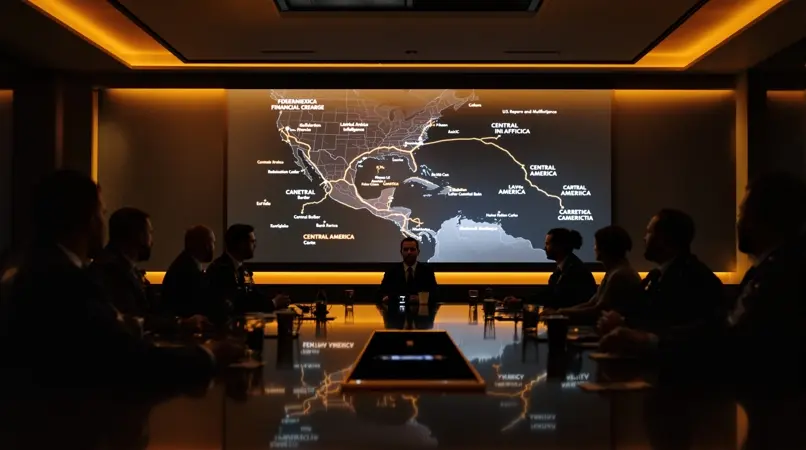
On August 10, 2026, the U.S. Department of the Treasury's Financial Crimes Enforcement Network convened law enforcement and financial institutions for a FinCEN Exchange, a public-private information-sharing engagement, focused squarely on one objective: combating the cartels. The readout confirms what the compliance community has suspected for months. Cartel financial activity is now among the highest-priority threats FinCEN is asking the financial system to help detect, disrupt, and report. For compliance teams, this is not a routine readout. It is a signal that the typologies, priorities, and information-sharing expectations around cartel activity have moved to the center of the BSA/AML agenda.
FinCEN Exchange is the strategic-level public-private information-sharing program, distinct from case-specific Section 314(b) sharing
FinCEN Exchange is the agency's flagship public-private partnership program. Established in 2017, it brings together law enforcement, national security agencies, and financial institutions in a structured setting to exchange strategic information about money laundering and terrorist financing threats. Unlike a Section 314(b) request, which involves case-specific sharing between individual institutions, FinCEN Exchange operates at the strategic level: law enforcement briefs participating institutions on emerging threats and priority typologies, and institutions respond with observations about the patterns they are seeing in their own transaction data. The goal is to convert the financial system's collective visibility into sharper, better-calibrated detection.
The FTO designation of cartels means their financial networks are treated with the same scrutiny as terrorist financing, intersecting both BSA and OFAC obligations
The August 10 engagement matters because of what it was focused on. Cartels. FinCEN did not convene a generic BSA information-sharing session. It convened a session dedicated to the financial infrastructure of the transnational criminal organizations that President Trump's administration has designated as Foreign Terrorist Organizations. That designation, formalized through executive action in early 2025, fundamentally changed the enforcement framework around cartel financial activity. A cartel is no longer simply a drug trafficking organization under the AML/CFT national priorities. It is now, in the eyes of U.S. policy and increasingly U.S. law enforcement practice, a terrorist organization whose financial networks are subject to the same scrutiny as those of designated terrorist groups.
Core typologies include trade-based money laundering, bulk cash smuggling, funnel accounts, MSB and prepaid abuse, and cryptocurrency conversion
The FTO designation is not a rhetorical flourish. It carries concrete consequences for financial institutions. Terrorist financing has long been the highest-priority threat in the BSA framework, and financial institutions have built mature detection and reporting capabilities around terrorist financing typologies. By designating cartels as FTOs, the administration has effectively told the financial system: apply that same rigor to cartel money laundering. Transactions that a compliance team might previously have categorized as generic narcotics-related suspicious activity now carry the weight of terrorist financing implications. The OFAC sanctions apparatus also intersects here, because the FTO designation brings cartel actors within the scope of sanctions screening and blocking obligations.
Cartel activity is distributed across institutions, making Section 314(b) sharing essential to assembling fragmented transaction data into a coherent picture
What are the cartel money laundering typologies financial institutions should be watching for? FinCEN's prior guidance, including the advisory on non-work authorized populations (FIN-2026-A002) and the recent Financial Trend Analysis on human smuggling, already describes several of the core patterns. Cartels launder proceeds through trade-based money laundering, over- and under-invoicing of cross-border commerce. They use bulk cash smuggling, moving physical currency across the southwest border. They rely on funnel accounts, where individuals deposit structured amounts into accounts controlled by the cartel network. They abuse money services businesses and prepaid access products. They use labor brokers and shell companies to run off-the-books payroll schemes. And increasingly, they convert proceeds through cryptocurrency and virtual asset channels.
The engagement sharpens existing SAR/CTR obligations, it does not create new filing requirements
The human smuggling connection deserves special emphasis. The Financial Trend Analysis FinCEN issued just days before this engagement documented nearly $5 billion in suspicious activity linked to human smuggling between 2023 and 2025, and the cartels control a substantial share of the smuggling corridors along the southwest border. Smuggling is not a separate problem from cartel activity; it is a cartel revenue stream. The payments that migrants and their families make to move through those corridors flow into the same financial networks that move narcotics proceeds. A compliance team that sees smuggling-related remittance patterns and a compliance team that sees narcotics-related funnel account activity are often looking at the same underlying organization.
Compliance teams should review monitoring calibration, train investigators on the FTO implications, and document their response before the next examination
For financial institutions, the August 10 engagement sharpens existing obligations rather than creating new ones. FinCEN did not issue a new regulation or a new filing requirement. What it did is signal, through the public-private forum, that cartel financial activity is now a coordinated, cross-agency enforcement priority, and that the financial system's role in detecting it is expected to be proactive and specific. The readout is best read alongside the AML/CFT national priorities, which already include Drug Trafficking Organization Activity and Transnational Criminal Organization Activity. The engagement tells institutions that those priorities are now being operationalized at the highest levels of law enforcement coordination.
The practical compliance response should begin with a review of transaction monitoring calibration. Do your current rules detect the cartel typologies: bulk cash structuring, funnel account patterns, trade-based value transfer anomalies, MSB abuse, and prepaid product misuse? Many institutions built their monitoring around generic narcotics indicators that may not surface the specific, coordinated patterns that characterize cartel financial networks. A cartel funnel account network, for example, often involves multiple accounts at multiple institutions receiving structured deposits from unrelated individuals in the same geographic area, a pattern that single-institution, single-account monitoring can miss entirely.
This is exactly where Section 314(b) information sharing becomes essential. Cartel networks are deliberately distributed across institutions precisely because they know that any single institution sees only a fragment of the total activity. Section 314(b) allows financial institutions to voluntarily share information with one another about suspected money laundering and terrorist financing, and it is the single most powerful tool institutions have for assembling the distributed fragments of cartel activity into a coherent picture. Institutions that are not currently registered for 314(b) sharing, or that have registered but rarely use the mechanism, should treat the August 10 engagement as a prompt to change that.
SAR narrative quality matters enormously in cartel investigations. When law enforcement receives a SAR that says a customer conducted unusual cash transactions, it provides limited investigative value. When it receives a SAR that describes structured deposits across multiple accounts, ties them to a specific geographic corridor, identifies the businesses or individuals involved, and references the cartel typology the activity matches, it becomes an actionable lead that can be combined with other filings to build a larger investigation. FinCEN's FinCEN Exchange program is designed, in part, to improve this feedback loop, to help institutions understand what law enforcement actually needs from a SAR narrative and file accordingly.
The compliance response should also include training. Front-line staff and SAR investigators need to understand the cartel typologies and how they differ from ordinary narcotics-related suspicious activity. The FTO designation changes the way these cases should be described internally and in filings. Investigators should know that cartel-related activity may implicate both BSA filing obligations and OFAC sanctions obligations, and that the two frameworks need to be evaluated together rather than in isolation. A transaction that triggers a SAR filing consideration may simultaneously trigger a sanctions screening hit, and both need to be handled through their respective procedures.
There is also a broader strategic point here about the direction of BSA enforcement. The August 10 engagement is one data point in a pattern that has been building throughout 2025 and 2026: FinCEN is moving the financial system toward a more operational, more coordinated, more threat-specific approach to AML. The FinCEN Exchange program, the Rapid Response Program, the expanded use of Geographic Targeting Orders, the FTO designation of cartels, and the proposed AML/CFT program rule all point in the same direction. Compliance programs that are calibrated to genuinely detect the specific threats FinCEN prioritizes, rather than to satisfy procedural checklists, will be the ones positioned to meet this environment.
The bottom line for compliance teams: treat the August 10 FinCEN Exchange readout as a priority-setting document, not a press release. Review your monitoring calibration against the cartel typologies. Register for or reinvigorate your Section 314(b) sharing. Train your investigators on the FTO designation and its implications for SAR narratives and sanctions screening. And document the steps you take, because the next regulatory examination will almost certainly ask what your institution did in response to FinCEN's cartel-focused public-private engagement.
FinCEN published the readout of the August 10 engagement on its website, and compliance teams should review it in full alongside the related FinCEN actions that contextualize it: the FIN-2026-A002 advisory on non-work authorized populations, the Financial Trend Analysis on human smuggling, and the human trafficking notice tied to the 2026 FIFA World Cup. Together, these documents describe a cartel financial ecosystem that the U.S. government is now systematically mapping, and that financial institutions are expected to help disrupt.